
There’s a term I keep hearing on photographic forums, describing lenses: “too clinical”.
When I tried to establish what it meant, it turns out it means, basically, that it’s good. The flaws are corrected, sharpness is excellent, and so on. One would expect this to be a good thing, but then I understood what they meant: there are no optical artefacts to cover their arse. You can’t pretend you’re an artist because the lens creates an artificial sense of nostalgia caused by flawed optics of yesteryear. If you remove optical defects, and one’s “art” disappears because the underlying “too clinical” image is revealed as empty and pointless, it’s not a lens problem, it’s a photographer problem.
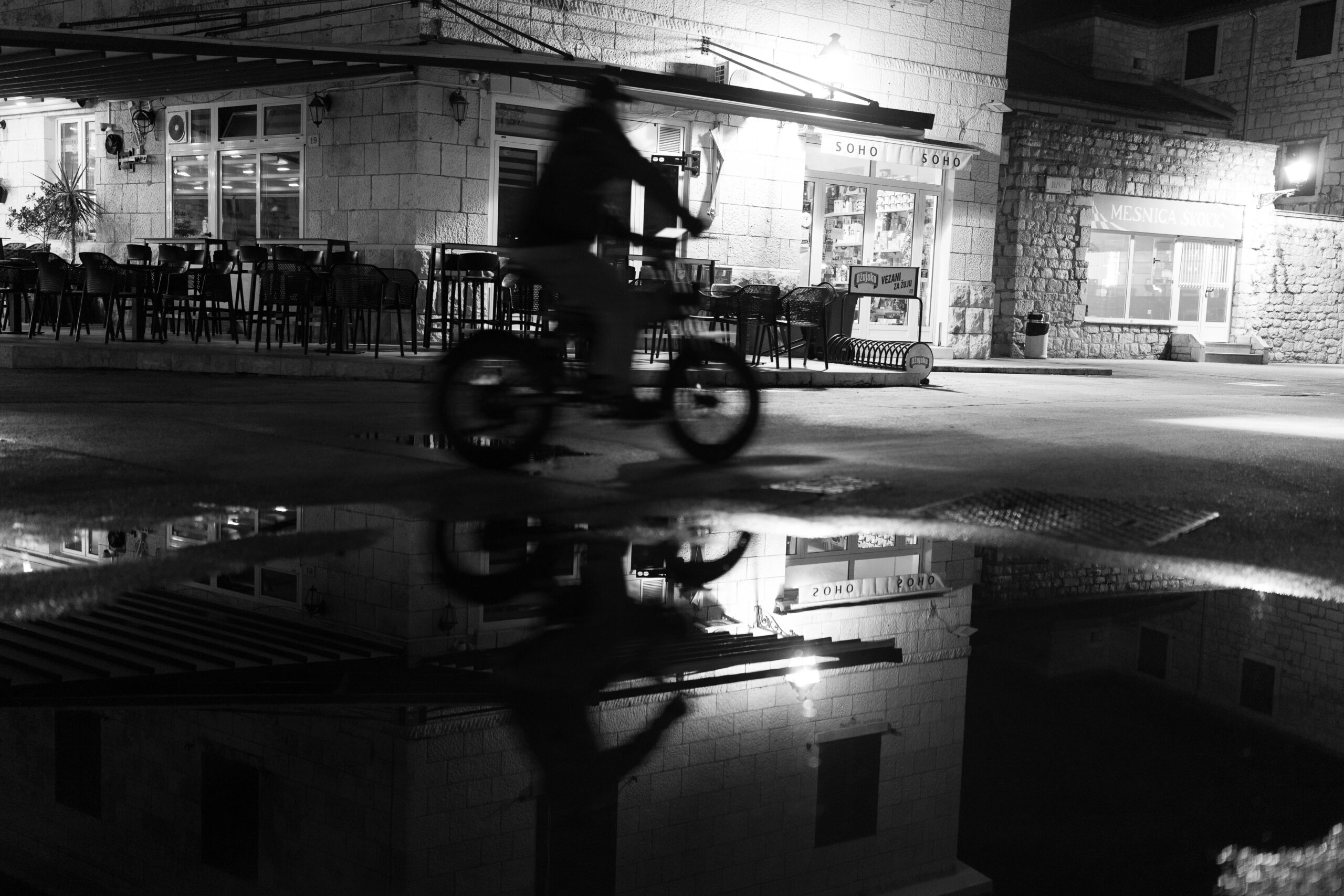
Taken with a very clinical lens on digital
I guess that’s the other side of the coin from people who think their pictures will stop being shit if they bought better lenses and cameras. There are people who make claims such as “double Gauss design is crap”, which shocked me immensely, as it is one of the best lens designs and some of the best work in the history of photography was produced by it. The reason why it’s “crap” is because the corner sharpness is quite poor wide open and remains weak until f/8 or so. There is also lots of chromatic aberration inherent to the design. Crap? Absolutely not. It’s a compromise that allows a 50mm lens to be small, light and cheap, which makes it one of the best optical designs in history. It leaves room for improvement if you make the lens big, heavy and expensive. Then you can have perfect corner sharpness at f/1.2.
People are exaggerating things greatly. In reality, yes, you can produce great work with flawed optics, and you can cover poor work under optical flaws and call it “character”. Sometimes, optical flaws can actually improve the image, for instance chromatic aberration can create “rainbows” on water droplets, and spherical aberration can introduce a “glow”. Sometimes, those effects can hit just right. I worked with flawed optics for decades, so I know how that works. Sometimes it’s wonderful, sometimes it ruins your image. In general, I prefer not to hide behind “character” of lenses. If you remove all of that and my photo is shit, then this is the truth of the situation: it’s just shit. Putting “character” on it just obscures the reality. I had that many times – tried to fix a photo in post, adding all kinds of effects, and it was still shit.

Sometimes, optical flaws actually help, but I wouldn’t make it a strategy.
Also, all the talk about colours is driving me crazy. I’ve seen a guy stating that default Sony colours are terrible, but with tweaking they can be made to look as great as Fuji colours, and then he shows some terrible crap with a greenish sky, that looks like a faded colour print that’s been kept near a stove since 1980s. I understand that those people in their 20s don’t actually know what film looked like when it was current; they know it only from the degraded, faded out stuff, and Fuji apparently panders to this illusion, creating jpeg profiles for their cameras that look like faded out or poorly processed film, because that’s what people think film is. If they processed film correctly, it would look “digital”. Also, I suspect lots of people making those claims about colours might be completely or partially colour blind. I shot film when it was actually good, and default Sony colour profiles are very film-like, and have been ever since R1, where the default profile looks very much like Kodak E100G, or, in amateur version, EB2 and EB3. The early profiles for A7II had very exaggerated greens, which in fact looked quite like Kodak EBX, or E100VS. The current profiles for A7RV look very film-like; the standard profile looks like E100G, and the vivid profile looks like Fuji Velvia, with its increased magenta tones. All in all, you can be sure that if I like the colours from it so much that I bought the second camera with the same sensor, there is very little room for improvement.

Fuji Velvia 100, Canon EOS 3, EF 85mm f/1.8
How can I be sure what film looks like? Because I made scans when it was current, and I checked them against the fresh slides on the lightbox. I know exactly what it looks like. Film looks “digital”, but when you would remove flaws from digital; make it sharper, less grainy and so on. It was very revealing when my son told me that, to him, 4×5” large format looks “digital”.
Today’s digital cameras are both very much film-like, and also much better than small-format film. I see it as a great thing. Also, the “clinical” lenses? Back in the day, those would have been called “dream lenses”. We did what we could with what we had, but this stuff we have today would have been seen as too good to be true, and if someone like Leica or Zeiss had made something like that, it would have cost a fortune. Only a few stellar designs from the past, such as the Zeiss APO Makro Planar, can compare with modern designs. Back in the day, we didn’t call them “clinical”, we called them dream lenses that everybody wanted, and only a few could afford.

Very clinical lens.
I was just thinking about this few days ago, when my Sigma 20mm f1.4 arrived. I looked at my photo backpack and couldn't believe how lucky I am, I have a bunch of great lenses for peanuts. Only thing I wouldn't mind having is a Sony 100-400, but my Tamron 70-300 serves me just fine for the time being. Then I remembered that some 19-20 years ago I had a conversation with a professional photographer who just bought some expensive stuff, and one of those lenses was priced at about 30k kn (cca 3k euros). At that time it was a fortune and you could buy a good used car for that money.
I'm not sure that those things used to cost that much more, but I'm quite sure we didn't have any money back then. 🙂
I remember from the E-1 time, I was looking at prime telephoto lens just out of curiosity and it was priced more than a new car I bought at that time 🙂
But that was prime telephoto used on soccer games – those were always super expensive and still are.
But looking today, A7R V (or even A7 III) with 24-105 lens far exceeds anything "pro" photographers had in that time.
I can do stuff they could only dream about, quite literally. Just name it – low light photos, super sharp photos, impressive nearly-all-sharp bursts, ability to print wall sized photos, ability to improve framing with crop and still make near-wall sized photos 🙂 and so on.
For that one album of the hunt I did recently, hunters nicknamed me "Lupino" 🙂
They were genuinely blown away with some photos, thinking I had something to do with it 🙂
Sure, I learned to kneel down when photographing dogs which improves framing – but the rest of it was all gear in that case – perfect eye tracking AI focusing system, superb sharpness combined with beautiful bokeh isolating subject and creating perception of depth, colors … and all that with >90% success rate – it was all gear and I even wasn't using 100-400 🙂
Taking photos like this 25 years ago was near fiction for someone without vast experience not to mention shooting stuff like this on film.
So yeah, gear reached near perfection levels and we can now shoot stuff we could only imagine before. And yet, when trying to shoot something nice and meaningful and moody, almost none of it matters … it's just easier to make shit photos than before 🙂
The biggest change for me was flying insects. Before, I had a handful of those over the decades; almost impossible to do with my hardware. Now, it's a matter of going out and trying, and I always come back with a few. It's an incredible difference and it's all down to technology.