
Some thoughts

I’ve been thinking about several things that are difficult to categorize, so I’ll write about all of them at once.

Why smart people make mistakes, for instance people predicting collapse of the global Dollar-based economy for years already, and evidence appears to contradict their predictions. It’s quite simple, really. They understand the deep underlying reality of the situation, but they underestimate the significance of other factors, such as meddling and interventions of very powerful players who desperately try to at least postpone the breakdown, if not completely alter its form. It’s only logical, if you assume the prediction is correct. It then also follows that the people in power will see what’s going on, and they are not going to take it sitting down. They are smart, and they have huge means at their disposal, and they have absolutely nothing to lose. They will print tens of trillions of fake digital dollars that will buy out the dollar bonds and then annihilate both. They will print a hundred paper-gold bonds for each gold bar, and sell them quickly to induce panic, and then when people start selling the actual physical gold, buy it with the fake Dollars they printed out of thin air, and then justify the printing of those Dollars with the newly acquired gold backing. Print trillions of dollars but suppress the price of dollar-backed oil, among other things by faking the existence of supposedly huge shale-oil supplies which are in fact thin air. Cripple the rest of the world with artificial roadblocks infiltrated into the payment system so that everybody else is fighting an uphill battle compared with the American companies. Print huge amounts of fake money and infuse them into your own technological companies to give you the upper hand. Print huge amounts of fake money and invest them into equally fake companies just to get them an IPO and bloat the GDP, retroactively justifying the printed amount with GDP numbers. Emit huge amounts of cheap credit into the economy to keep it on life support, while making the rest of the world pay for it, and if someone objects, threaten them with sanctions and war.

Most smart economists understand that the foundations of the Dollar and the American economy itself are untenable, and yet they fail to understand the lengths to which the players who created this system will go to defend it. Also, they see that the collapse will be a great disaster, yet they fail to actually use this as a premise and think from the position of the people in power who see the same thing, but also have the mechanisms at their disposals to do the otherwise unthinkable things – create a war that will hide and transform the collapse, from the “emperor is naked” testimony of fraud and theft that is the basis of the modern America, into a completely different narrative, that of “evil enemies of democracy” who attack and subvert America at every angle, to the point where they caused the great economic collapse itself, at which point America had no choice but to retaliate with nuclear weapons, but alas, it incurred heavy casualties, and all this chaos and destruction is actually someone else’s fault.

I actually think everybody was right – the people who see the geostrategic situation and understand that it is precursory to nuclear war, the people who see the foundations of the Dollar economy and understand that it is untenable and collapse of the debt economy is inevitable, the people who sense unclear doom and prepare, the people who fear the technocratic surveillance state, the people who fear the collapse of the Western civilization and its moral and intellectual foundations. They are all right, and it’s all happening on the same vector. It’s just that they underestimate the people who are actually guiding the process.

They are not stupid, and regardless of what they are telling you, they themselves understand perfectly well what’s going on, they have excellent analysts, military strategists and economists at their disposal and when they make and implement plans, they are incredibly more far-reaching and layered than most people are willing to accept. Imagine what would be going on if I was in charge of this thing, and if I had the wealth and power of America at my disposal to implement everything. I would be playing at 20 chessboards at once, with hundreds of people as smart as myself delegated to specific tasks. If you think you would be able to see what I’m doing from the outside, or predict events based on some part of the pattern you’re perceiving, then you’re naïve beyond belief. I would cook up specific points of chaos in order to divert attention of all other players, play feints and counter-feints intended for obscuring the sight of their analysts, introduce dozens of legitimate issues they can’t ignore while not being sure which one is the real attack-vector, and I would have a perfectly calm mind while stirring up the fogs of war that increase other players’ emotional potential, making their thinking slower and more inert, more prone to distraction.

That’s why smart people make mistakes. They don’t understand the power and ferocity of the guiding intelligence of the enemy. Sure, it’s easy to say it’s naïve to perceive the economy in the state of deep manipulation for decades and pretend there’s nobody at the wheel, that it’s just instinctual trading, reflex of self-preservation of the bankers, greed and power, but it’s actually emotionally preferable to the recognition that it’s all the result of people smarter than yourself at the wheel, with all the power in the world at their disposal, and that most of the events that seem unrelated are actually intelligent moves, most likely aided by artificial intelligence which simulates moves and their likely effects for the players, so that they can pick the best strategy against the simulated rational self-serving opposition.

If you gave me a trillion dollars, that’s what I would do – have the game-theory experts design and supervise the acres of supercomputing technology running AI software, and have it running a very detailed simulation of the real world, displaying the probable responses of all the world powers, set up the scenario very similar to the actual state, and then run millions of various scenarios, until you map out those with the highest probability of you ending up on top. If you think they are simulating the climate, and not simulating this, with all the computer game technology being there for decades, where you can run a combination of Civilization, Sim City and Starcraft on computers the size of a smaller city, running tens of thousands of teraflops-level computation units in parallel, well, let’s say I’m not betting high by predicting this. The thing is, human emotional responses are easy to predict, and it gets easier the bigger the group, so it actually gets easier when you’re trying to work on a nation-level. You give the computer the option to tweak variables, and it will end up with something that will look very weird, disconnected, not at all like figures on the same chess board, the way computers come up with weird optical designs when you apply them to making lenses. However, when you actually grind that weirdly looking piece of glass into the aspheric shape recommended by the computer, you see that it actually works.

That’s my problem with the AI. The computers themselves are incredibly stupid, and are no danger. However, when you take those computers, with their enormous quantitative power of simulating trillions of outcomes and pruning the tree of options until you get something that’s useful, and give them to extremely smart people, who work for extremely evil people, you end up with a nightmare of incredible proportions.
JP Morgan warns about Dollar decline

Read this.

…we believe the dollar could lose its status as the world’s dominant currency (which could see it depreciate over the medium term) due to structural reasons as well as cyclical impediments  

As such, diversifying dollar exposure by placing a higher weighting on other currencies in developed markets and in Asia, as well as precious metals makes sense today.

… Being the world’s unit of account has given the United States what former French Finance Minister Valery d’Estaing called an “exorbitant privilege” by being able to purchase imports and issue debt in its own currency and run persistent deficits seemingly without consequence…

There is nothing to suggest that the dollar dominance should remain in perpetuity. In fact, the dominant international currency has changed many times throughout history going back thousands of years as the world’s economic center has shifted.

… In other words, in the coming decades we think the world economy will transition from U.S. and USD dominance toward a system where Asia wields greater power. In currency space, this means the USD will likely lose value compared to a basket of other currencies, including precious commodities like gold.

… Central banks across the globe are also adding to gold reserves at their strongest pace on record. 2018 saw the strongest demand for gold from central banks since 1971 and a rolling four-quarter sum of gold purchases is the strongest on record.2 To us, this makes sense: gold is a stable source of value with thousands of years of trust among humans supporting it.

Given the persistent—and rising—deficits in the United States (in both fiscal and trade), we believe the U.S. dollar could become vulnerable to a loss of value relative to a more diversified basket of currencies, including gold. As we scan client portfolios, we see that many of them have far more U.S. dollar exposure than we feel is prudent.

My interpretation: Jim Sinclair was right that the central banks intend to do a “soft landing” inflatory move, devaluing the Dollar (and Euro will, in my opinion, devalue even more since the EU has an even worse internal crisis on top of Euro being essentially a Dollar-derivative). According to Sinclair, this first controlled inflatory attempt will fail, and as a result there will be a second, “natural” inflatory event that will balance the world economy on actual values.

So, nobody can say they haven’t been warned. According to some rumors, JP Morgan has been accumulating immensely large amounts of silver recently, so you can’t say they aren’t backing up their talk with money.

As for crypto, I agree with Peter Schiff that crypto will be the first thing to collapse, and that will actually make fiat currencies look good. Everybody invested in crypto will be wiped out. The exception are the blockchain-based technologies backed by actual assets, like the Russian crypto-Ruble. After that, everybody holding significant portion of their assets in fiat currencies or their derivatives such as dollar and euro denominated bonds will be wiped out. The current rise of gold and silver is just a precursory warning shot, and I still recommend buying.

The disclaimer is that this only applies to people who actually have significant savings. If you reduce your cash supply below one month’s needs, you are actually putting yourself in harm’s way. Instead, stock up on canned and other long-lasting food (pasta, flour, sugar, beans), because in a hyperinflatory environment food supply might get disrupted. I don’t know how long this might last, so there’s no harm in assuming it might last long enough for everybody who didn’t prepare to regret it. Have in mind that I’m following my own advice, which means I’m taking this shit very seriously.

Inflation

How much is a German Mark (DEM) worth in Euros?

This is something intended for the Europeans in general and citizens of the former Yugoslavia in particular, since we used to do our inflation-hedging by doing everything in DEM. So, we must still remember how much is a DEM worth.

1 EUR is 2 DEM, right? That’s the conversion rate that was used when the Euro was introduced. And I caught myself thinking about that, implicitly assuming this conversion rate when I was thinking about the housing prices in the past, when a square meter in Zagreb used to cost somewhere around 1000 DEM, with the highest prices reaching 2500 DEM and the lowest being around 500 DEM. I was thinking how the prices went to Jupiter since then, as they are now between 1000 and 3000 EUR per square meter. That would be 2000-6000 DEM. Or would it?

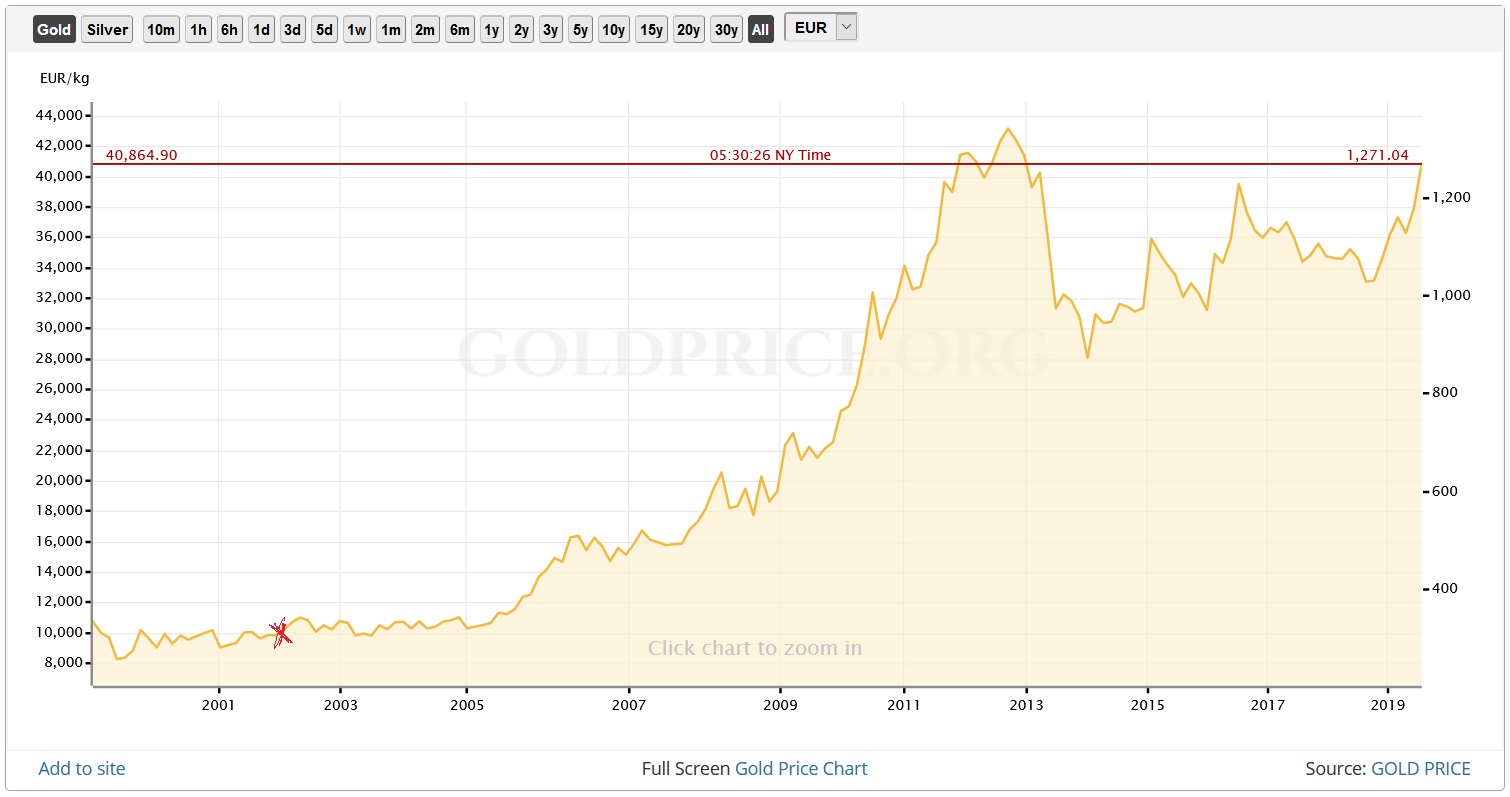
And then I thought of a good way of verifying my calculations: the historic gold price chart in EUR:

The red X marks the spot where EUR replaced the former currencies in circulation; its value is 10000 EUR per kilo of gold. This means the value of DEM is 20000 per kilo of gold.

Today the price of EUR is above 40000 per kilo of gold. This means its actual value dropped by the factor of four since introduction, and the value of DEM, in today’s Euros, would be 2 EUR. So the exchange rate would still be 1:2, only the other way around.

So, the cost of housing in Zagreb today, recalculated using gold as the standard, would be 500 DEM for the cheapest, 700 for the normal, and 1500+ for the high-end of the range. Basically, that means that the prices got more affordable, in terms of gold per m2.

As a conclusion, no, the real estate is not going through the roof, and no, gold is not going through the roof. It’s the paper currency that’s gone down, by a factor of 4 in the time span of 17 years. You will ask why nobody told us? I will ask, why do you think they would want you to know? Your faith in their bullshit currency is what gives it value. Your faith is a commodity. You and I are just cattle that’s bred for slaughter. You don’t tell the cows the prices of meat and milk on the market. So, if you were a good boy and saved your euros somewhere in a bank, you are now rewarded by being poorer by a factor of 4. If you had your savings in real-estate or gold, you’re fine.


Analysis of the economy

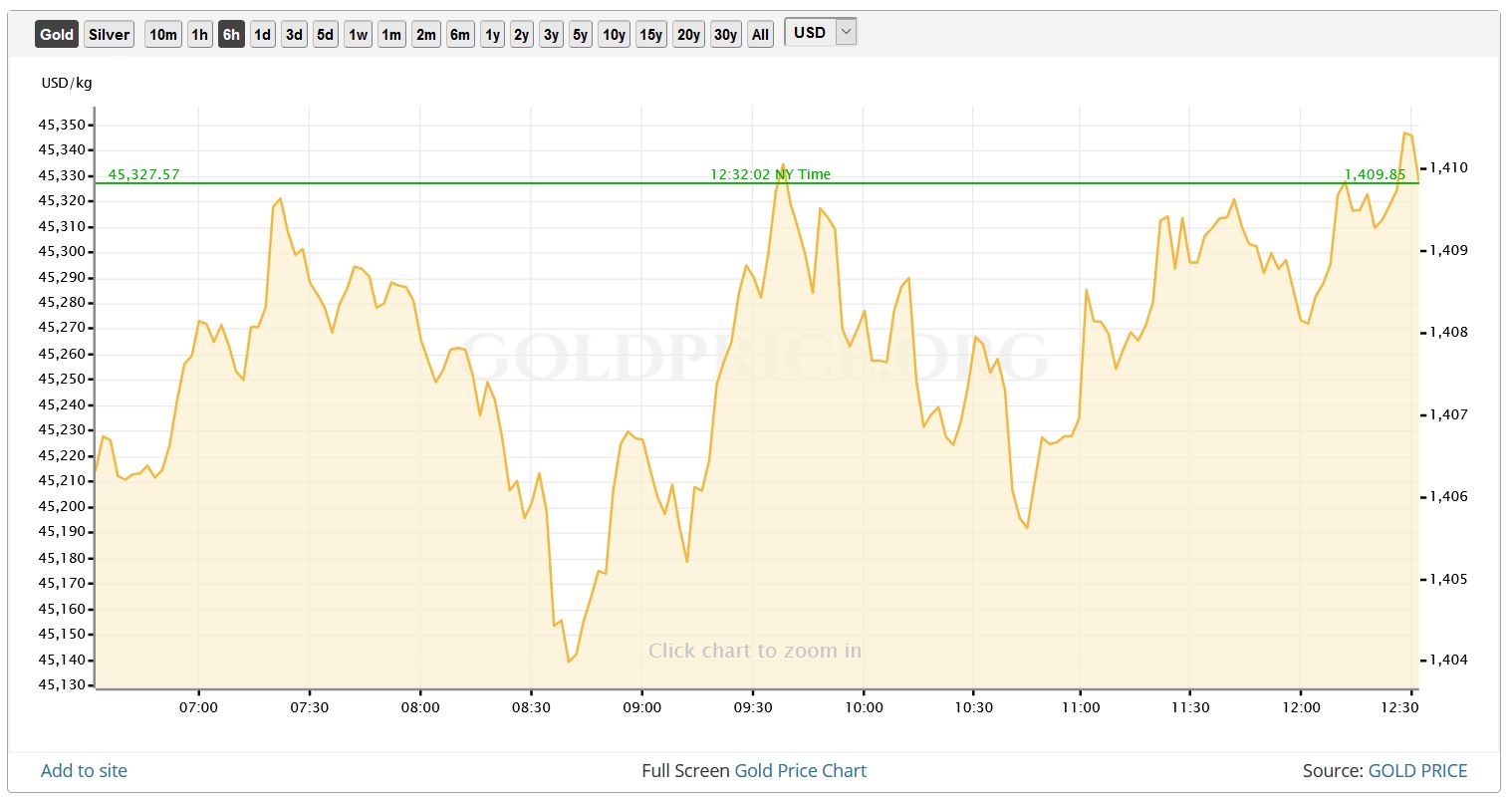
The auto-selling scripts are intervening into the gold market by selling lots of paper gold above $1400 in order to stabilize the price.

This has been set up in advance, apparently, and I think it’s the last-ditch effort to control the hyperinflation. Also, Trump’s anti-crypto message might precede concrete actions to completely outlaw the crypto market in order to block the rats leaving the sinking USD ship. Both things seem to be related. When convertibility of crypto into USD is blocked, the value of crypto, for all intents and purposes, measurable in real world money, will be zero, because it will literally not be convertible into money.

When the water breaks through the dam, my guess is they will try to blame it on Russia and China doing some cyber attack or other fabricated bullshit, and then they’ll start a total war. It will be “use it or lose it” scenario, because when the dollar and Euro collapse, they will no longer be able to fund their military under a “business as usual” scenario. I simply can’t envision a scenario where America just lets that happen and peacefully endures their version of the collapse of the Soviet Union, especially since they’ve been deploying all kinds of preparations for exactly this scenario for quite some years.


On bad advice

Let me discuss some ideas that I consider to be rather bad, but which are expressed frequently online, or they exist as a custom, at least regionally.

The first such idea is “stacking silver”, basically converting part of your monthly income into silver and adding it to your stash, as a form of inflation-proof savings. This makes sense in countries where there is no additional tax on the purchase of silver bullion. In the EU, there is up to 25% of VAT on silver, which makes it an enormously bad idea as a form of saving money, since you lose up to 25% of your income on every transaction, and that doesn’t even account for the losses you will incur on sale. Silver is for Americans, and since the majority of silver-stacking youtubers are Americans, that might seem as a good and commonly practised idea; in Europe, it is not. There is a catch, though. There is no VAT on pre-owned silver, so that might be a good idea to buy, but generally speaking, you need to see what makes the most sense in your country and region.

Things that make sense in America are suicidally dumb somewhere else. For instance, investing in the stock market in Croatia is almost guaranteed to give you a loss; I looked at the investment funds managed by the banks here several times and they all reported negligible or negative income. Investing in stocks in the USA is a sound financial advice, at least until the stock market crash wipes you out. Don’t just listen to advice online and think it’s universally applicable. Also, you can’t just put money somewhere and expect it to do well. You need to actively manage it, for instance if you hold investment papers, you need to always have an eye not only on the stock market, but on the overall state of the economy as well, and you can’t just have someone manage it for you, because you need to know when to get out, and I’m sure the investment fund managers aren’t going to tell you that.

There’s a regional custom of giving your children gold coins, usually for religious or educational milestones. I buy mine new computers, because guess what, gold in the amounts I could give them is useless, and computers, in today’s world, are how you learn to create income. You first need to learn how to make money, and for that you need to invest in yourself, in new tools and in acquiring marketable skills. The same goes for your children. You can’t just send them to school and hope they will magically learn something marketable there, because guess what, almost nobody does. For learning how to take care of yourself, in the sense of creating an income stream, school is worse than useless.

My kids tell me they are all communists there and tell them incredibly stupid ideas such as “you need to do the things you love as a job”. How about no. You need to learn how to do many things, have diverse skills, and then figure out which one of the things you can do, or can quickly train yourself to do, will make you the most money, and then make that your job. Avoid things people would like to do, or which they do as a hobby. That’s the financial red waters, places with many sharks or crocodiles in not much water.

Another horrible idea is saving money; not universally, but if you start too soon. If you’re a teenager or living on small income, don’t buy silver or gold coins with your pocket money and think you’ll have a huge stack of money when you’re older. No, you’ll be poor and stupid. Invest in your skills, buy the tools you need to do jobs, instead of buying silver every month rent an online server and learn how to write code, and then sell services online, or something like that, something that will get your income started, something that aims at the broad global market. Don’t listen to people who tell you to mow lawns or wash cars for money. That’s what they did, and it might have made sense 30 or 50 years ago, but it no longer does. You need to establish a global presence, learn to swim in the great ocean immediately, because all the smaller waters are red with blood and sharks. Everybody there is competing with the global market anyway, so the money you can make is terrible, basically your prices are globalized and your marketplace is local. The worst combination you can have. You have nothing to lose from going global immediately. So, for the greatest part of your career you need to avoid saving money; you need to invest it in yourself and your business, because you don’t have a good income yet, and saving a percentage of almost nothing is, well, less than almost nothing every month. Keep your money in your business, in your tools, and in growing your abilities and business contacts. Of course, that will only get you so far, so there’s no sense in overpaying for tools because that won’t get you anywhere, but if you really need that new iMac because you’re writing iOS code, then you need that new iMac. That’s the core tool of your business. But if you’re writing PHP code in Linux, just get a good monitor, mouse and keyboard, and you’ll save lots of money on hardware by not buying a Mac. It all depends on what you do. As a rule, it makes sense to buy the cheapest tools that will get the work done, but not cheaper than that. Depending on your business, you’ll know that point where overpaying for tools no longer makes any difference in your performance, and just decreases your profitability. So, at that point it might make sense to invest that money in hiring people, instead of just throwing it into equipment. That way you can gradually get your business to the point where it’s working even if you’re not. Which brings us to the most important point.

Avoid types of jobs where each additional unit of money means you need to do an additional unit of work. That’s what my father did for a living, and that’s how I learned it’s not good. He was/is a sci/tech translator, and for each 10 EUR of income he had to translate a page of text. That’s a very reliable way of being poor and at a huge long-term financial risk, because when you’re sick or when you need to retire, you’re basically fucked. You need to create passive income, things that produce money even when you’re not there working. You don’t want to be unloading watermelons from trucks and being paid per watermelon or per hour. You want to be in a position where you own a company with ten workers, five of which write/maintain code, five of which sell, give user support and do paperwork, and you want to be in a position of finding other areas to branch into, thinking of ideas about future products, and while you’re doing it, code gets written and products get sold, and nothing had ground to a halt just because you had a flu.

Also, if your parents aren’t wealthy self-made businessmen, you need to understand that everything they taught you was probably wrong, and school didn’t help a bit. I was in such a position regarding finances and earning money; everything I knew about it was wrong, and produced costly mistakes, but I had to stumble along and learn things the hard way, until I got to the point where I’m teaching my kids the things you can learn from wealthy people online, but which I didn’t listen to because everything I knew was wrong and I didn’t know it was wrong. That’s the most dangerous position to find oneself in, because when you think you know how things work, and you’re wrong, you don’t feel like shutting up and learning. Also, while I was learning it the hard way there wasn’t really anything useful on the Internet.

Now comes the strange part: break those rules whenever necessary. Do completely non-profitable things just to help others whenever you feel like it. Save money if you don’t have an obvious investment path ahead of you, and then you’ll have the means to exploit an opening when it does occur. Do incremental work until it’s possible to generate a passive income stream, and even when you have a passive income stream, just to complement it, because income streams fail. Listen to the experienced people, but have in mind that things change and the world today has opportunities and openings much different from those before, and don’t be afraid to plunge into something new and untested, especially if you’re young enough and you can afford the experiments. Do things locally if there’s a good business opportunity, and especially if you can extend it online and create a broader market later. Basically, when listening to advice, including mine, use your brain first, and see what’s actually applicable and useful for your specific situation.