Vulgar materialism

I had a weird experience on a photographic forum in the recent months. Essentially, I was praising the optical qualities of a cheap lens, the Sony FE 28-60mm f/4-5.6, and someone reacted as if the very possibility of a cheap lens being as sharp as the top quality lenses was a personal insult to his pay-to-win worldview.

This is why people mischaracterise the FE 50mm f/1.8 as a “beginner lens”, something you “graduate from” to a more expensive, high quality lens. It just can’t be that a cheap lens can be good. It’s good if you don’t really have experience with the expensive stuff, but if you did, if you could afford the expensive glass, of course you would get it, right? Praising cheap lenses is certainly a coping mechanism for poor people.

FE 28-60mm f/4-5.6

I find this line of thinking extremely annoying. OK, I understand there are insecure people who are trying to turn everything into a status symbol, and it’s probably some aspect of aspirational buying characteristic for people of a materialistic worldview, who think possession of things gives them value. It’s also why sharpness became so overused in assessing picture quality; it’s measurable, and it’s also highly dependent on equipment, and as such, you can make it into a pay-to-win proposition; he who has sharpest pictures wins, and he who has the most money will be able to buy equipment that makes the sharpest pictures. So, obviously, my proposition that a 200 EUR lens can be as sharp at f/8-11 apertures as any expensive GM lens is something that is seen as so incredibly offensive to the materialistic worldview, that it needs to be rejected as outright preposterous and clearly a coping mechanism of someone who can’t afford the GM glass.

Only, I can. I have a pretty extensive collection of high grade lenses, and I do actually know what I’m talking about. As far as sharpness and resistance to flare are concerned, the cheap 28-60mm zoom really does hold its own against glass of the highest grade. This makes it ideal for some use cases. People should be happy about it – after all, if a cheap lens can do the job, they don’t have to waste money on an expensive one, right?

You would think, but that’s hardly the case. It’s as if being inexpensive automatically makes a lens suspect. Even if people are happy with the lens itself, they will “upgrade” from it as soon as possible, simply because it’s cheap and they don’t wish to be associated with cheap equipment. It’s for the beginners, for people who don’t really know.

FE 50mm f/1.8

Do you know what I did after I bought the FE 50mm f/1.2 GM lens? The best, sharpest, brightest 50mm prime? The replacement for my FE 50mm f/1.8 “nifty fifty”? I kept using the cheap f/1.8 whenever I needed a light, inconspicuous, versatile lens. As for the f/1.2 GM, it’s absolutely great. Completely free of the optical flaws the cheap lens manifests wide open and against the light. Autofocus is instantaneous and incredibly accurate, unlike the cheap lens, whose AF is its worst aspect. But the secret is, from f/2.8 onwards the two lenses are mostly indistinguishable. The cheap lens is optically extremely good when you use it the way you should for most things. Of course I kept using the 50mm f/1.8 for things where it’s actually better; things like keeping it light and not looking like a professional.

So, I didn’t “graduate” from a cheap 50mm lens to a professional one. I didn’t replace the cheap lens. I merely added a new high-quality tool to my arsenal. The cheap lens is still excellent and I use it when the advantages of the more expensive lens are irrelevant. For instance, if I am shooting landscapes in good light, both lenses are going to be used at f/8. Autofocus is going to lock instantly on both in this use case. Sharpness is going to be the same. However, one is going to be lighter to carry. As for the image quality, I already had situations where I looked back at the pictures and thought “ah, the f/1.2 GM is so incredibly sharp here”, only to look at the EXIF and find out that the picture was taken with the cheap 50mm f/1.8. So yes, I will have to disappoint the crowd that sees this as a pay-to-win competition where most money gets you the sharpest pictures. Sharpness is in fact one of the easiest things to achieve inexpensively. You do, however, have to know what you’re doing, which is a different matter entirely.

But if you can get sharpness at high resolution with inexpensive lenses, why did I even get all those expensive GM lenses? Because there’s sharpness, and there’s sharpness of that one single crisp detail in a sea of blurred-out colour.

FE 50mm f/1.2 GM

FE 50mm f/1.2 GM

Because I hate chromatic aberrations messing up my shots at contrasty details against the light. Because I like shooting in low light, when the colours are particularly “meaty”, and I like shooting wide open, at extreme apertures, while still retaining critical resolution in landscape shots. My photographic style is such that I can actually use those extreme optics for what they are made. I want things blurry, and yet clear and crisp at the same time.

FE 100-400mm f/4.5-5.6 GM

That’s the part that’s hard to get, and I had to pay through the nose for it. It’s just what it is. If I could get away with a cheap lens, be completely sure that I would have used one. In fact, I do have a few cheap lenses that I use regularly, because they are what works the best in some cases. They are not inferior lenses – merely inexpensive because there’s a compromise that doesn’t matter for my intended use case. For instance, I have a Sigma 24mm f/3.5 DG DN, which I bought very inexpensively, but its picture quality is stellar, build quality is incredible, and it’s very small and light.

Sigma 24mm f/3.5 DG DN

The compromise? It’s a f/3.5 lens, so aperture is limited compared to the more expensive lenses. I don’t care, because I shoot it mostly at f/8-11. It’s a wide angle lens; I don’t care to have extreme aperture on it, and I also already have one extreme aperture wideangle for the situations where I want to use it hand held with the stars visible in the sky. I need this one to be crisp, resistant to flare and light, which it is. It’s just not a bokeh monster. However, if you want optical quality, it’s absolutely top notch. It’s the lens I use when I want pictures to look as if they were taken with a smartphone, only without the stupid artefacts.

Being inexpensive, however, seems to be an unforgivable crime for some people. If a piece of gear is guilty of that crime, no amount of stellar performance can absolve it, and it needs to be avoided so that people wouldn’t suspect you of not having enough money to afford the “really good stuff”.

I’ve been thinking about this mentality a lot lately, since I keep encountering it. It’s as if some people have a desperate need of showing everybody that they have money. One would expect it to be something poor people do in order to hide their desperate financial situation, and they do. It is also, however, something very rich people do if they happened to have a really shitty financial situation earlier in life, like Andrew Tate. When he goes to a restaurant, he orders the most expensive steak. When a waiter asks him for his exact preference, it turns out that “most expensive” is his preference. One would expect a rich person to just order what he wants to eat that day, and not care about prices at all, and I am certain that most do. Some, however, always need to have the most expensive thing, so that people wouldn’t suspect them of being poor, because they were so traumatised by being poor, they started acting in the most ridiculously ostentatious manner once they got into money. I find such behaviour distasteful. If you can’t wear an excellent Seiko because of what people would think, or you can’t drive a normal car because of what people would think, you can’t have furniture from Ikea because of what people would think, and you can’t be seen with an excellent “kit zoom” on your camera because of what people would think, trust me, you have bigger problems than what people would think.

Busy

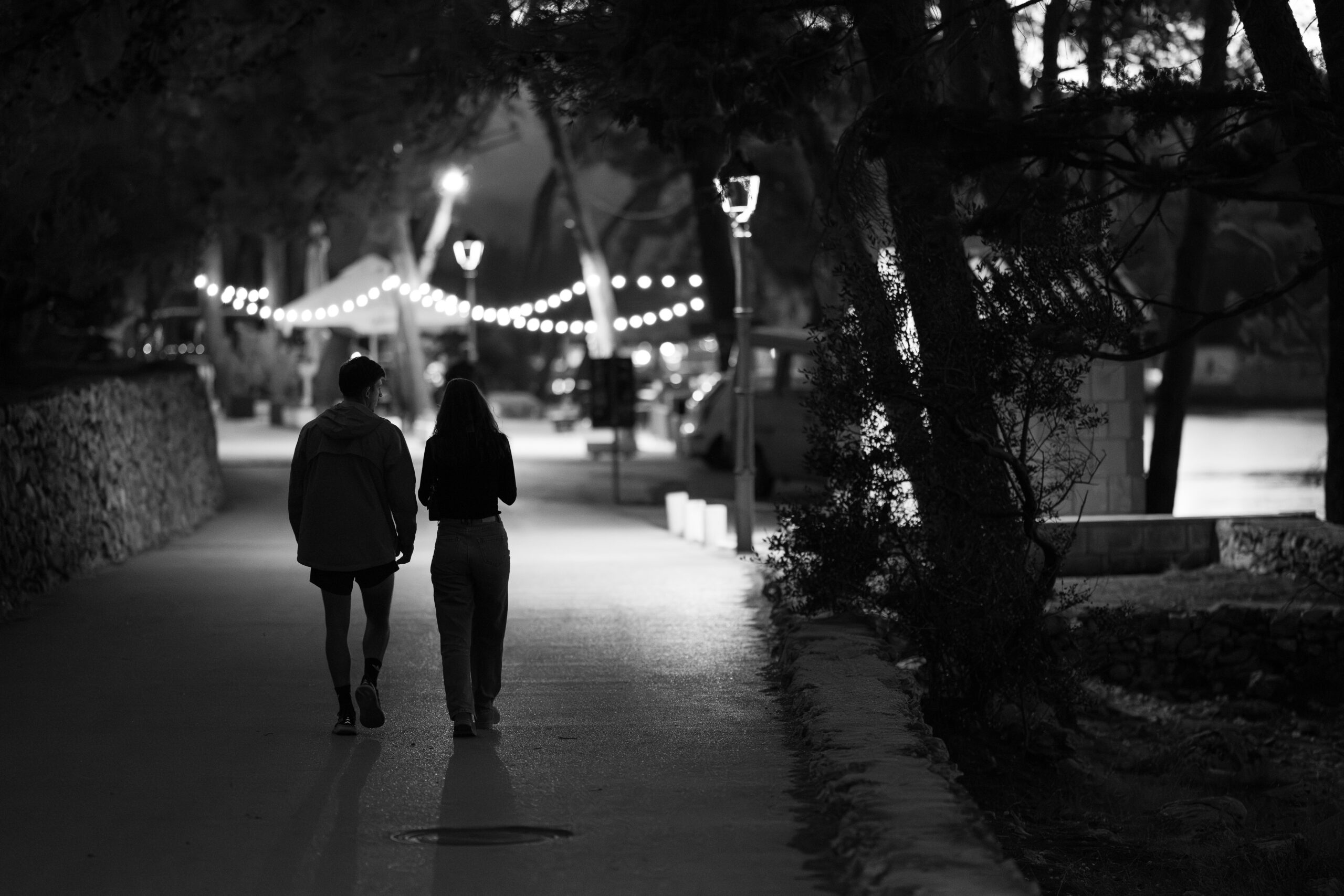
I was kind of preoccupied last week or so, and it wasn’t just one thing. I did, however, get some nice pictures this evening.

A7CR with the Sigma 24mm f/3.5 DG DN kicks serious ass for such walks; mostly because the combination is very small and light.

I was thinking about many things.

For instance, how people routinely misunderstand everything I say about spending karma, because it’s such an uncommon thing that almost nobody has any experience with it, and they misinterpret it as some kind of rationalization for depression and so on. It’s absolutely nothing of the kind. People have no experience with it because they are mostly busy creating sinful actions and rationalising them; if they actually ever feel remorse for their actions, it’s usually a rare, almost once in a lifetime event. Spending other people’s karma… that’s exceedingly rare, and most people don’t even understand the mechanism, or the possibility of such a thing. People are afraid of this kind of a spiritual pain to the point that they wrap its potential causes under all kinds of insulation, and when that fails, they tend to completely break down. That one would willingly endure that, and to no fault of one’s own, is beyond their comprehension. So, they invent interpretations, which are of course as wrong as they are silly.

The same goes for darshan. No, it’s not something I can pull out of my arse when I’m feeling bad. I wish. It’s not something you can remember, invoke, reconstruct or imagine. When it’s not there, it’s not there and there’s nothing you can do about it. When it’s there, it’s like the light being suddenly turned on in the dark – and human experience in general is a very dark thing, compared to that. This is the true light, something you can’t even imagine until it’s there, and it’s so much not under my control that I had literal decades without such experiences, and I couldn’t do anything about it either. You can’t remember it, because a memory is merely a shadow, something of a lower dimension of existence, like a faded photograph compared to the actual person. You can’t cause it when it’s absent, the way you can’t cause someone dead to appear merely because you miss them. When people think it’s something I imagined in order to comfort myself, I find it incredibly silly, because if that were so, I wouldn’t have to endure decades without it then. No, it’s an absolutely genuine phenomenon: a person of God stopping by to say “hi”. If you haven’t experienced it, you certainly can’t imagine what it’s like.

There’s a good reason why those two things – spending of karma, and darshan of God – are such opposite experiences. Sin by definition binds you to darkness that is the opposite of the light of God. When Christians talk about sin being something that removes you from God, they do actually know what they are talking about, because that’s exactly how it works. So, when you’re processing sin, it’s the least desirable experience possible for someone who loves God. It’s a combination of pain and spiritual darkness, low energy and all kinds of energetic, physical and emotional damage. It is, however, an extremely effective way of growing your soul and increasing your spiritual powers. It doesn’t feel like it when It’s ongoing; in fact, it feels like being immersed in a spiritual equivalent of raw sewage. But in pauses, when you can feel your purity, power and all sorts of new good stuff that wasn’t there before, it feels very much worth it. But when it starts again, you think: if I ever say anything is worth this, beat me with a spiked club please. 🙂

It’s a vastly unpleasant cure for a terrible thing, but its ultimate fruits are incredible.

Can anyone do it? Well, start with your own, I guess. Everybody has abundance of sin to purify with remorse, and if they don’t think they do, it just means they are so totally immersed in darkness, they lack even the concept of God’s light. There’s a reason why saints talk about their sins, and sinners talk about how much they love and accept themselves. The reason is, when God’s light turns on, you see yourself in true perspective, and you can finally admit what you truly are, in an absolute sense. When you are in complete darkness, you feel the need to comfort yourself, convince yourself you’re fine. None of that exists in the presence of God. If there are impurities, they hurt. You feel a strong need to do something about them. The true perspective is so great that it makes it possible for you to admit things you had to hide from earlier. It’s a strange thing – in a sense, both sinners and saints lie. The sinners lie that they are good, and the saints lie that they are bad.

As I said, I’m thinking about many things.

Some thoughts

We hiked up our local hill yesterday after the summer heat had cleared, and we got some nice sunset colours.

Most pictures ended up being the typical sunset shots, because that stuff seems to be irresistible, but I got some that are different; sunset merely illuminating the things and giving them a 3d glow. I ended up liking those the most.

Trump, being himself, let it slip that the West has for the most part no more than 4 weeks of oil reserves, which is unsurprising since they’ve been using them up foolishly in order to prevent the oil prices from going up too much, which would reflect poorly on the popularity of the politicians and their foolish wars. Since the current “agreement” between Iran and the USA is of such flimsy nature that the sides can’t even agree enough to publish the same version of what’s supposedly being agreed upon, there’s not much chance of any peace there taking root, at least until Israel gets its way, nukes Iran and gets wiped off the map in return.

I noticed one thing changing in my attitude towards the Apple ecosystem, and Apple Silicon in particular. I no longer see them as an experiment, a thing I’m testing to see if it’s long term viable, while maintaining a backup Intel based system that could take over in case it all fizzles out. It became my primary system, while everything else is essentially obsolete. I know exactly how that came to be. When I was writing the last book, and especially when I was proofreading it, I pretty much exhausted myself to the point of almost passing out, and I noticed that I removed that margin that I always maintain – if the computer breaks, dies, crashes or fubars the data, I am usually always ready to do something. This time, I was so tired that I relied on the computers – the 15″ M4 Air, and the Studio M2 Max – to do everything perfectly because I was simply too tired to do anything about it. And they did – they were both incredibly fast, reliable and good, and nothing went wrong in any way. One would think that after all the decades of IT progress that would be expected and unsurprising, but it isn’t. My Windows desktop, the Ryzen machine, is unreliable to the point of randomly bluescreening whenever I really push it. It probably means that the CPU is damaged and can’t handle the thermal load, or something; but since a machine bluescreening under load means loss of data, I simply stopped using it for anything other than games. I had to push the machines when I was finishing the book – not care how many things I left open, not care how big images I imported into Photoshop for the covers, not care how many layers I had; I just needed to get the job done, and I did the covers after proofreading for multiple days in a row, and had the machine crashed during that, I’d probably throw it out the window and make it a lawn ornament. But it didn’t crash. It didn’t slow down, it didn’t glitch, didn’t do any of the stupid shit I came to expect from both Windows and Linux, and I could rely on both the OS and the hardware to pull me through when I was half-conscious from work. As a result, something changed in my attitude; I now treat Apple Silicon machines as serious stuff I rely on, and I treat everything else as toys. I bought another laptop, the 13″ M5 Air, the 16/512GB model. It’s not that the 15″ did anything wrong; to the contrary, it’s the best laptop I ever had. I wrote almost the entire book on it, and it did everything flawlessly. It’s just that I like having 13″ laptops for some things, and all my other 13″ machines are either old and expected to fail sooner rather than later, or they are much, much worse than Apple Silicon in almost every way. For some things, such as making the covers or editing photos, I use the Studio with a 43″ screen. For some things I use the 15″ laptop, and for some things I use the small one. I think it’s similar to how guitar players have multiple guitars they use for playing different things.

Over the years, I experimented with different kinds of laptops, and I discovered that a very powerful desktop replacement machine is the least useful for me, because I rarely need that kind of power on a laptop. I need it where I need the big screen for editing pictures, and that’s a desktop. I need a laptop to have an excellent keyboard, touchpad, screen and battery, and to be fast enough for all the things I run on a laptop. This ends up being everything other than photo editing, so basically I have photo editing machines and “everything else” machines. This explains why I prefer the Macbook Air to the Pro – the pro models have active cooling and more power, but they are thicker, heavier and more expensive for the virtue of being great for the things I don’t actually use the laptop for. As a result, I managed to “cook” the 15″ Air only twice, and both cases took place in a hotel when I was importing a batch of 350 or so 61MP raw files into Lightroom. To its credit, it actually managed to hold its own and be as fast as my Studio for the first 100 or so pictures, but then it throttled itself to less than half its nominal speed and it was pegged at 100°C. Also to its credit, it managed to actually import everything just fine, and I proceeded to edit everything on the hot laptop and functionally speaking, I got the job done. Would I like doing it regularly, no. But also, would I like buying a 5000 EUR machine that is better at something I do twice a year, while also being so much bulkier and less practical for everything else I actually use it for? Hard pass.

On the other hand, the Studio is a complete opposite. The Air has incredible speed and power, until it hits the thermal limit. The Studio M2 Max is actually somewhat weaker in that range. However, it never hits the thermal limit. It can keep going at 100% load, for hours, days, weeks or years, and it will never give a single fuck. The machine is under-specced for my new 61MP cameras because I bought it for processing 24MP files, so things that used to run instantaneously now take time. The thing is, I don’t necessarily care. I have it import the files while I take a shower, it gets stuff done, and I never have to think about overheating it, stressing it by having it work for too long on 100%, or anything like that. It’s like a rock crushing machine that just crushes rocks for years and doesn’t give a fuck. Also, unlike other powerful machines, it is always completely silent. And unlike my equally powerful Ryzen machine, it never bluescreens.

No wonder Apple ate everybody’s lunch. It’s the thing you need when you’re done with everybody else’s shit and you just need to rely on things to do their job because it’s important, and you don’t have the patience for drivers acting up or the OS update locking up the machine just when you need it, or something crashing and taking your files with it. When you need a rock crusher that works 24/7, and you really depend on it doing the job, maybe it’s not the time for solutions that require you to reserve a part of your mental capacity for fixing the mess after the machine inevitably shits itself.

So yeah.

Do I actually need a zillion computers? Does Mike Oldfield actually need a zillion guitars? Yes, in fact. It’s weird how that works, but this is no place for minimalism.

No news

Not much to report on – I’m spending terrible karmic stuff in great quantities and I’m barely functioning. The summer is upon us, so it’s hot. I’ve taken some pictures of the butterflies on the lavender, because that’s still the best motive around. The difference is, I now used an ultrawide lens to do it, because I don’t want to become too repetitive with the telephoto/macro setup.

It’s getting too hot to take walks during the middle of the day. It was 34°C in the shade today, we went out to have lunch and we’re cooked. This means we’ll have to switch into summer mode, which means walks in the late evening. It is what it is. Also, I’m allergic to something that’s in the air currently, and I don’t know what because there are too many candidates – half the island is under flowers of some kind or another. Tiny annoyances in addition to the big problem.


Pause

We had a slight pause with photography in the recent days, for several reasons. The most important one is that the amount of karmic mass for spending that we had to deal with has been consistently high, and then periodically it increases exponentially and ruins my day completely, because I need to focus only on that and can’t even pretend I’m doing something else. The second reason is that the weather has been very windy, and since the main subject matter now would be lavender blossom with insects on it, you can imagine how long thin stalks of lavender behave in the wind.

The stalks can move multiple centimeters per second in the wind. Dept of field is 2-3 centimeters max. So, we kind of have an excuse to not go out and take pictures.

Romana got more into photography lately and so I explained to her last night how I don’t just go out with a camera, see a butterfly on a flower and take a picture. Most of the picture is pre-planned before I leave home. I think about what I’d like to shoot, and then I visualise what I would like the picture to look like. The light needs to be like this, the scene needs to be lit like this, the composition needs to look like this, and then I come to the equipment – what lens do I need for such a picture, at what aperture. Then I wait for the time of day when the light will look right, and go to a place where the light will strike from the right direction, and I expect some subject matter to exist. So, before I even took out the camera, most of the picture elements have already been set up. Then I find the “background subject matter”, basically the kind of flowers and leaves that will look good in that light, and then I try to find cooperative insects to compose them into that as the motive that will carry the composition. So it’s not that I just happen to get lucky. Part of it is luck – if I’m hunting for butterflies, there’s no guarantee that I’ll find any, and especially that I’ll find cooperative ones that came to the flower bush to eat, and not just fly away across the path. I need it to stand there and eat, on the right flowers, in the right light, and I need to have the right lens on the right camera. So, basically, I need to have everything else pre-selected and hope I get lucky with the butterfly. Sometimes I come back empty handed, and you don’t hear about that. Sometimes I get lucky and the butterfly that’s just right lands on the flowers that are just right, and it looks easy.

What does it mean, that I don’t just spontaneously take those pictures because I happen to live on Hvar and I happen to have great equipment that does everything? 🙂 Oh shock, oh betrayal. 🙂

Of course it’s all planned and technical. It’s not that meditation turns into pictures by pointing the expensive camera in the general direction of the island.