
The long-term prospects

I’m going to let you in on a little secret about a doomsday device that threatens with mass extinction of the vast majority of all species on Earth, including mankind. This device has been created 41 million years ago and has been steadily working on cooling the planet down, reducing the amount of CO2 in the atmosphere, increasing the temperature gradient between the poles and the equator. It has cooled the planet down so much that the existence of permanent ice sheets on the poles has become the norm for the last few millions of years. Lately, it rendered the climate so fatally unstable, that the Milankovitch cycles, the small variations in orbital eccentricity, axial tilt and precession, have become sufficient to plunge the planet into ice ages – or, considering that we are in an ongoing ice age, we should call those the “glacial maximums”. Inevitably, as the process of global cooling progresses, those small variations will at one point cease to be sufficient for bringing the planet out from a glacial maximum, and further on, it will cause a global glaciation, also known as “snowball Earth”.

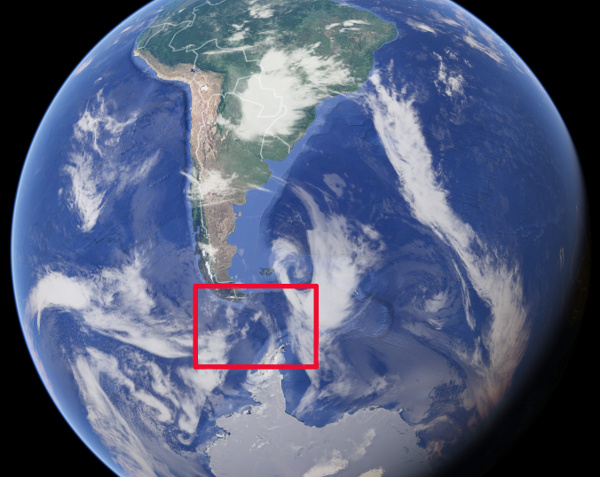
This doomsday device is known in geography as the Drake Passage.
drake_passage

To quote Wikipedia, “There is no significant land anywhere around the world at the latitudes of Drake Passage, which is important to the unimpeded flow of the Antarctic Circumpolar Current which carries a huge volume of water (about 600 times the flow of the Amazon River) through the Passage and around Antarctica.”

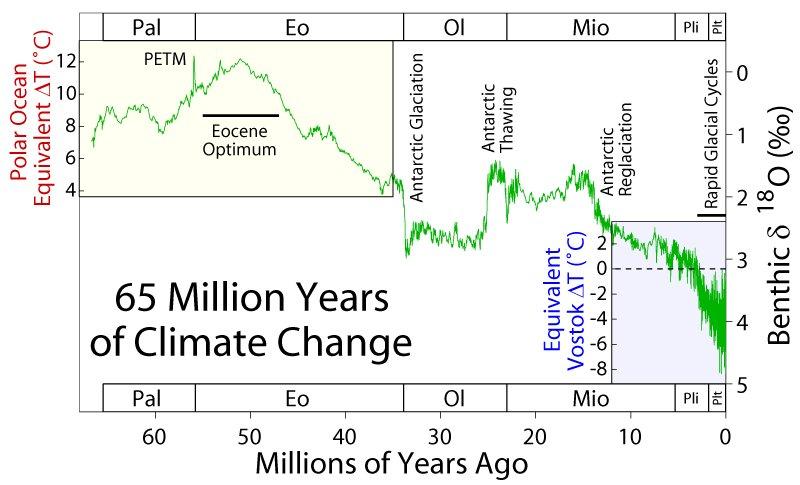
Some 65 MY ago, due to plate tectonics things started taking place, that gradually rearranged the flow of sea currents around the continents. The Drake Passage was opened 41 MY ago, separating South America from Antarctica. This created a steady Antarctic circumpolar current which is basically a Coriolis-effect-driven heat pump, and you can understand how that works if you imagine a rotating cold vessel filled with liquid, where rotation of the vessel helps the exchange of heat between the two, only in this case the liquid flows outside the “vessel”. The liquid spins inside the vessel due to inertia. It essentially cools warm seawater by exchanging its heat with the edges of the polar continent where it dissipates into space. The effectiveness of this circumpolar current in dissipating the energy from Earth is such that it creates a net-negative energy balance, although a slight one, and creates a long-term trend.

This long-term cooling trend is what drove the evolutionary forces that created our kind of mammalian life, and it’s the trend that will eventually result in a complete global freeze that will produce the final extinction of our kind of mammalian life. This is the reason why there are no longer any large ectothermic creatures around, such as the Titanoboa, why the birds needed to evolve the ability to migrate seasonally in order to avoid the freezing cold of the north hemisphere winter, and why the mammals needed to evolve in order to hibernate. Closer to our time, the formation of the isthmus of Panama some 5 MY ago impeded the equatorial sea currents, forcing them to circumnavigate the continents and thus bring more equatorial heat into the southern circumpolar current. This had the “immediate” effect of throwing us into a Pleistocene ice age, since the global temperature and the amount of CO2 buffering plummeted to the point where Milankovitch cycles could actually have a significant effect on the climate.
long-term temperature trend

The temperature graph of the last 65 MY has a long-term downward trend, and everything else is merely a blip.

The formation of the Antarctic circumpolar current started the long process of climate change that produced us, the creatures of the Ice Age, and it will also produce the end-result of freezing Earth so completely, that it will stay there for hundreds of millions of years, until plate tectonics eventually rearrange the continents in such a way as to produce a net-positive global energy balance and cause a gradual thaw, at which point every form of life we know and are will be long extinct.

It happened already, several times, and every time the continental masses were arranged in such a way as to enable free circulation of sea water around at least one pole. The only time such circulation was inhibited we had the Cambrian explosion of life, and when it was re-established 41 MY ago we had the acceleration of the process of global cooling that started 65 MY ago when the continents rearranged themselves in a way that creates a net-negative long-term global energy balance.

One of the problems with global cooling is that CO2 is more readily absorbed in cold water, and this long-term global trend sinks our atmospheric CO2 into the oceans and thus removes the buffer that would otherwise reduce the thermal gradient between the equator and the poles and also moderate the slight effects that Milankovitch cycles have on global climate. That’s why Milankovitch cycles are of consequence only in the Pleistocene, which is what got me interested in the first place, leading to very interesting findings that I’m describing here.

This short-term increase in atmospheric CO2 concentration that we managed to produce with our high-energy civilization might have bought us some time, by temporarily increasing the climate buffers and reducing the impact of the orbital and axial variations on the climate, but since Earth is a very complex thermodynamic system, where circulation of 3 mediums (magma in the mantle, water and air) and entropy within and between them, solid impediments to circulation, plus solar input and albedo, plus thermal buffers (methane, CO2, water vapour) and accumulators (ice, methane hydrate), produce effects that are impossible predict without a very demanding computer simulation, we currently don’t know what exactly to expect, and as far as I’m concerned, the CO2 input could influence some mechanism in such a way that it actually causes a sudden ice age, for instance by introducing too much fresh water from ice melt into the oceans and thus disrupting the thermohaline circulation. When I watched the movie “Day after tomorrow”, the events described seemed implausible, but after I did some research I actually think it’s one of the most likely scenarios I’ve seen described. The thing is, we don’t know, because it isn’t about logic, it’s about thermodynamics, and you need to know all the variables in order to be able to predict, and one single thing can decide between radically different outcomes.

But this is all short term. Long term, the sentence is death by cold. How long term? In Pleistocene, the climate became unstable. These are in fact the death throes of climate that precede the global glaciation, where Milankovitch cycles are no longer sufficient to produce a glacial minimum, and you get a runaway glaciation. What exactly are the conditions in which this takes place, in respect to oceanic and atmospheric temperature, albedo and CO2 concentration, I don’t know, because that would require a computer simulation. What I do know is what the long-term temperature graph looks like, I understand the underlying mechanism, and I can predict that within a few million years we will have frozen oceans on the equator. But for all I know, there’s another interesting trend, which shows that the dominant Homo species goes extinct in the glacial maximum – Homo Erectus, Homo Neanderthalensis and others. I don’t see great odds of our industrial civilization surviving an event as disruptive as a glacial maximum, and without industry, and having killed off all the Pleistocene megafauna that would allow at least a moderate number of humans to live off the land if the industrial agriculture fails, I’m not giving us the odds of survival greater than 1% in the timeframe of 50 KY. But of course, for a species to which 1 KY is “eternity” and which no longer has any kind of historical recollection of the last glacial maximum, even those prospects are incredibly long-term.


References:

Impact of Antarctic Circumpolar Current Development on Late Paleogene Ocean Structure, Miriam E. Katz, Benjamin S. Cramer, J. R. Toggweiler, Gar Esmay, Chengjie Liu, Kenneth G. Miller, Yair Rosenthal, Bridget S. Wade, James D. Wright
Science 27 May 2011:
Vol. 332, Issue 6033, pp. 1076-1079
DOI: 10.1126/science.1202122

Role of the isthmus of Panama in global cooling by Gerald H. Haug, Geoforschungszentrum Potsdam (GFZ), Germany; Ralf Tiedemann, Forschungszentrum fur Marine Geowissenschaften, Germany; and Lloyd D. Keigwin, Woods Hole Oceanographic Institution

65 MY trend of cooling, David Lappi

The Physics of the Antarctic Circumpolar Current, Worth D. Nowlin, Jr., and John M. Klinck, REVIEWS OF GEOPHYSICS, VOL. 24, NO. 3, PAGES 469-491, AUGUST 1986, Department of Oceanooraphy, Texas A&M University, College Station

Why walk when you can teleport?

I’ve been watching Youtube videos with people restoring old computers to full functionality and using outdated equipment to perform tasks, and it’s been bothering me for non-obvious reasons, and I was thinking why that is.

Why use a i7-6700K when a Q8200 will do? Why use a modern smartphone when a 5 year old device will do?

It will do exactly what? Just now, I took an old netbook from my “outdated shit bin”, installed a modern version of Linux on it together with all essential apps in order to test whether it will “do”. The touchpad is shit, the display is shit, it is slow and although it does perform basic functions, like writing documents, answering mail, watching videos and playing music, it does everything poorly and with delays. So yes, it will “do” if you can’t afford a modern well made device, but if you can, by all means do because it’s worth it. Elimination of all those delays and nagging flaws has a very liberating psychological effect akin to removing painfully tight clothes or shoes; you don’t know how much it was bothering you until it stops. So one thing that was bothering me with the concept of reusing outdated equipment was the concept of deliberately putting up with bad things that can be avoided simple because you rationalized the good thing as “too expensive to be worth it”. It’s too expensive to be worth it if it gives you no actual benefit (like a gold-plated phone), but this excuse seems to be overused in order to rationalize not being able to afford things that are quantifiably better. I’m often not able to afford things, but I try not to resort to a “sour grapes” excuse. Instead I usually say something like “yes, x would be better but I can’t afford it so I use y, which is cheaper, not so good but I can get the basic functionality out of it”.

The other concept that’s bothering me is that I can recognize some urge to use minimalistic tools, the worst possible stuff that still gets the job done, in order to avoid the trap of the law of diminished returns that always rears its ugly head when you try to use the best possible tools to do the job. That makes sense when you just need a good hammer, not the best hammer in the world, because you occasionally need to hammer some nails, not do it all day, every day, for a whole year. But the problem with this is that when you try to buy the least expensive tools, they occasionally fail, and they always fail when you need them. Even if they don’t fail, they usually do a shitty job. I have a pair of cheap water pump pliers that keep slipping and performing poorly, and I never get to actually replace them because the good ones are more expensive and I’m not sure they will perform better. But I use those twice a year on average so it’s not a big deal, it’s just evidence that there indeed are bad tools and that being cheap can bite you.

There’s more, of course. There’s also a question of “why try to be rich when you can do everything with less money”, as a rationalization for staying poor. There is a limit, of course, where additional money doesn’t really get you any additional real quality of life, because you simply run out of useful things to buy. This amount of money, however, is huge; it’s probably in a billion-dollar range, and even in the open-ended range you can use the money to influence the entire civilization, by financing things that would otherwise make no economical sense, like spaceflight or pure science.

It comes down to “why would you need a car when you have your feet”, or “why would you need a forklift when you have your arms”, and, essentially, to “why do you need power”.

You need power because being limitless is better than being limited, because being powerful is better than being powerless, being great is better than being small, and a wonderful thing is better than a shitty thing, although a shitty thing is often better than nothing at all.

People love fast cars not because they couldn’t do everything with a slower and cheaper vehicle, but because a fast car gives you the feeling of unrestrained freedom that reminds you of the state in which you existed before you were born in this limiting existence. People love power because it reminds them of freedom and the joy of not being restrained in everything you attempt. That’s why settling for the inferior things disturbs me – because it looks like giving up on ever being able to see God again, and be free and unrestrained and powerful. It looks like the final acceptance of defeat. Of course, things will not give you that which you lost, but once you start giving up on greatness, you might actually mindscrew yourself into ultimate spiritual failure.

Social networking as an orgasm button

In my last article I come off as a technophobe of a sort, or at least a techno-skeptic, and weird as that might sound, I think this perception might actually be accurate. I think of technology as a tool for solving problems and doing things that you want to do. If it creates more problems than it solves, does it really fulfill its purpose?

I’m a techno-skeptic (with a dozen working computers of all kinds in the household) because I see how people use technology. If someone was spending his life hanging out in a bar and wasting time in superficial, shallow conversations, we would recognize this as socially unacceptable, something worthy individuals don’t do. However, this is exactly what social media is: shallow people wasting time in superficial quasi-dialogue, and it’s all worthless and going nowhere. The only one actually profiting from it all is the bar owner.

Technology gives every kid an opportunity to become the smartest person who ever lived. You can buy a Raspberry Pi for a few dollars, plug it into a TV, keyboard and mouse, and install a free Linux OS on it that allows you to access the vast tomes of knowledge on the web, play multimedia and write code in multiple programming languages. And how many use it for that? How many of you did sudo apt-get install gcc?

For 200 EUR you can buy a smartphone that’s actually a 8-core pocket supercomputer with Geekbench 3 score of over 4000. You can load it with a library of books and music, you can use it to access Wikipedia and Wolfram Alpha, you can use it as a multiple-language dictionary, interactive road map with satellite navigation, you can use it to SSH-connect into a remote server, to write and execute Python code, essentially you can do everything a personal computer can do, that doesn’t require a keyboard and a big screen. Its price makes it accessible to almost anyone, and even for 50 EUR you can get a device that gives you most of those capabilities. Based on that, you would expect the people who own such devices, and the even more powerful ones, to be the smartest and most capable of all people who ever lived. Instead, they are barely literate, with poor mental focus, disastrous social skills, horribly limited general knowledge, are ignorant of history, philosophy, politics, art and science, they have very poor understanding of technology in general, and people in the 19th century would see them as retarded scum that lacks both education and proper upbringing.

Does it mean that I think that children should not own smartphones and computers? Of course not. My kids use whatever technology they need. They both have laptop computers and mobile phones. They both play videogames. However, they play Minecraft and Universe Sandbox, not Call of duty, and to them computers and mobile phones are not a life-substitute, but a tool. The older one can write code in Logo, Python and some c, and the younger one can tell you everything about masses and composition of planets in the solar system. Guess why? They read, they talk to adults, they use their brains.

The worst thing that can happen to children is to spend too much time talking to other children, because with other children there’s no positive intellectual and emotional differential, there’s just ignorance, prejudice, and a very violent and abusive pecking order. One of the main reasons why elderly people were so respected in the traditional communities is that they used to talk to children, to teach them true and useful knowledge, and do it in a calm and peaceful way that would unplug the children from the frenzy the other children caused. Children are actually the worst thing that can happen to children, because the only thing children usually learn in the company of other children is how to establish an abusive comparative ranking based on usually completely arbitrary criteria, because kids are too stupid and immature to know what’s really important.

And that’s exactly what people use modern technology for: they use it to entertain themselves and to participate in some social network with arbitrary and worthless comparative ranking. They thirst for attention and approval, and dread ridicule and criticism, and in they fears they primarily dole out ridicule and criticism. Essentially, the entire social network is a cesspool of ignorance, prejudice, ridicule and criticism of others and never satiated desire for approval. In order to earn others’ approval, people adopt one of the few memes and quasi-philosophies, and there’s no place for real diversity of opinion, because if you want approval of others there’s only one thing you want: you want a choice, an opinion and a philosophy that will earn you most approval, and everything else is secondary. That’s why you want the best phone, the best computer, the best camera, the best philosophy: you want others to recognize you as worthy and to approve of you.

You know what I told my kids about peer pressure and desire for peer approval? “Just accept the fact that you’ll never be accepted by all people, or even the majority of people. The only way you can get approval of idiots is to be an even worse idiot than they are. The only way to get approval of average people is to be slightly below average. What you need to do is accept the fact that whatever you do and whatever you choose, someone will try to shit on you. Even if you’re Jesus they’ll crucify you. That’s how people are and that’s what they do, and the thing is, you can never know if they are sincere, if someone is shitting on you because he honestly dislikes what you do, or if he’s just jealous. You need to measure your success by how much you are succeeding at realizing your personal goals, not by what others say. If you want feedback from others, ask the adults, who actually have a developed brain and a reasonable set of criteria, not children who are stupid and immature.”

That’s how people are abusing the technology. They use it to try to get peer approval, and instead they get to participate in a giant hen-house as a part of the pecking order, where they don’t learn anything really useful, except how to efficiently insult others and make them feel worthless, because they know what worked on them.

If you only let go of people and their bullshit approval, you can find great stuff on the Internet, stuff that can make all that technology worth while. You can find an abundance of downloadable books and music, that you can store on your mobile device and read. You can find excellent articles about ancient Rome and topology on Wikipedia. You can find analytical tools that can interpret common language queries as mathematical equations. Or you can get caught in some meme in order to get group approval on some forum.

I always use the best technology I can afford, if I find it useful. You should, too. However, to use it in order to create a virtual pub in which you’ll waste time trying to “be popular” is an abuse of opportunity. So, it turns out that I’m not really skeptical of technology; I just think most people are idiots to whom technologically facilitated social networking is as harmful as an orgasm button to a rat: it feels good, but eventually the poor animal dies of hunger and thirst pressing the damn thing all day.

Idiots and their smartphones

If you asked a person on the street whether he thinks he’s smarter than a stone age person, he’d probably say yes. If you asked him whether he thinks he’s smarter than someone from the Roman empire, or the “dark ages”, the answer would probably be the same. After all, he knows that Earth revolves around the Sun, and owns a smartphone and a computer.

The interesting thing about smartphones is that I asked my son what do the kids in his class have – he’s 6th grade. It tuned out that most have the top-tier devices like iPhone, Samsung Galaxy 6 edge and Sony Xperia Z5. It’s a jaw-dropping piece of information considering how those kids are not really geniuses; they get average grades, are of average intelligence and are not especially well brought up, to put it more kindly than they deserve. You would ask, what are they using their super-devices for? Games, of course, Facebook and some chat app that’s currently “in”.

Do they use those things to read up on Wikipedia? Not really. Do they use them to navigate Google Earth and see different parts of the world? Not really. Are they reading the news to find out what’s going on in the world? Not really. Are they using them for reading books? Not really. In fact, my son told me they laughed at him when he told them he reads books, because “we’re not in the 13th century to read books”. So basically, those children are idiots with very expensive toys. They are as stupid as a brick, and if you think they would come on top in a comparison with a person from ancient Rome, you are probably wrong.

So, if you strip a today’s person of his technology, how much does he really know, what can he really do, and how much is he really worth?

If you try to reduce social media to the actual message that is shared, it’s all mostly “look at me, I’m a vain, shallow, stupid idiot that’s exactly the same as everybody else; nothing worth seeing here, but do click me because I seek attention”.

The kids in my son’s class act as if there’s a difference between having this or that smartphone, but is there, really? If you waste 10 hours a day hanging out on Facebook, as some of them apparently do, does a better phone help you waste time more effectively, or do you just feel cooler and more important as you do it?

If you strip Augustine or Thomas Aquinas of technology and dress him in rags, does it change what he is? But do it with one of those modern fancy girls who are so full of themselves they can’t stop shooting selfies with their phone and posting them online. Strip her of technology, wash her of her make-up and dress her in rags, and tell me, does it change what she is? What is she, really, if everything she is can be stripped away by removing the superficial?

About death and meaning

For materialistic and godless people, the entirety of ethics seems to revolve around avoiding death and discomfort. The magnitude of evil is defined by the body count. The magnitude of goodness is defined by the number of live bodies added or preserved.

Death is so feared, as the ultimate evil and the ultimate foe, that old and mortally ill people are not allowed to die, and their meaningless agony is prolonged to the extents previously unimaginable, just because the living are unable to cope with the inevitability of their passing.

Death is so feared, that NDE reports are summarily ignored and swept under the rug, because they disagree with the common, materialistic perceptions about death and, even more importantly, the meaning of life.

Even the Catholic Church, which is usually the island of sanity and reason in the vast ocean of madness, has since the Second Vatican council adopted the ridiculous position that life is the supreme virtue. If so, is then nothing more important in life than staying alive? Is there absolutely nothing worth dying for, except, of course, keeping a greater number of people alive? What about truth, holiness, faith? What about eternity? Are we not advised to abandon this life for the sake of eternal life, and are we not warned that whomever attempts to save his life, will lose it? Is birth control really the most important issue for us to deal with, or should we let the dead bury their dead, while we reach for the life eternal?

Is the “right to live” really more important than the duty to love God, and man in whom we see God?

If death is indeed the enemy, why then does Paul greet it as the end of the race, where winners are to be proclaimed and prize is to be won?

If life is indeed the supreme value, why then did Jesus submit himself to the will of God and willingly choose suffering and death, on the narrow path?

If we are indeed to fear death as the prince of all evils, have we not already lost the battle for the meaning of life?

And if life has no meaning, why does it have value, and why is it virtuous to preserve it?