
Right reasons

I’d just like to make one thing clear.

When one is suffering from material adversity, and they think material solutions are going to improve their situation, for instance they are cold during winter because they can’t afford heating, they are eating bad quality food or starving because they don’t have money, or they don’t have a good housing solution because they are destitute, they are more-less completely justified in their thinking. Money would indeed improve their situation, because the problem is caused by the lack of money. Materialism, in a sense of desiring things for their material properties, such as desiring a warm blanket when you’re cold or a good meal when you’re starving, will indeed solve a material problem. I’m not saying you should not desire material things for their material properties. It’s only reasonable to do so.

What I’m saying is, don’t desire material things for their abstract, ideal or spiritual properties, because that’s bullshit and a trap. Associating spiritual conditions with material conditions is a form of projection and bondage of spirit to the material world, and it’s a terrible idea.

Basically, it’s perfectly fine to want a car that is comfortable, fast, safe and durable. That’s what a car should be, as a physical object, and you’re perfectly reasonable to want one. The problem is when you associate ownership of a certain brand or model of a car with some spiritual state or achievement, and you think owning it will mean that you made it, that you attained success.

In fact, it’s going to have only its physical properties, and its brand-related social-status properties are going to have some effect, but never what you hope for or expect, and sometimes the exact opposite. Illusions of that kind are notoriously fickle.

Buying for the physical properties is, for instance, how I buy lenses. It’s a matter of how sharp, what aperture, how free of optical defects, how heavy, how well built, and how expensive. I make a list of all those properties and the winner is usually the lens that has the best image quality, but not at the expense of twice the mass and twice the money. It needs to be a reasonable balance of properties. Also, brand name doesn’t actually mean much to me. I owned so many brands of gear that I don’t care, but I will prefer the original manufacturer of the camera because of the possible incompatibilities of the electronics, because they are a thing, to the point that I recently had to replace Biljana’s Sigma 105mm EX DG OS HSM macro lens for Canon because the electronics were so glitchy or outright malfunctioning on her Canon RF system, that no amount of optical perfection could make up for the issues. It is one of the optically most perfect lenses I’ve seen, and it was replaced because it’s unreliable and possibly electronically faulty.

I don’t give a shit about mythical brands and their mythical properties. I care about tangibles, about actual performance and what I personally perceive of image quality. I care about the brand being well adopted in the professional circles, because then it’s going to continue to exist and the system isn’t going to die and force me to change it. Also, if it’s popular, the manufacturer is going to earn lots of money, and that means new good lenses and cameras. That’s why I avoid small exotic brands. Give me something that the professionals use as their bread and butter system; if it’s good for them, it will be good for me. And the ultimate test is going to be image quality. If I’m not getting the image quality I want, I’m going to dump it. If it works for me, I’ll be as happy as a hog in a field of corn.
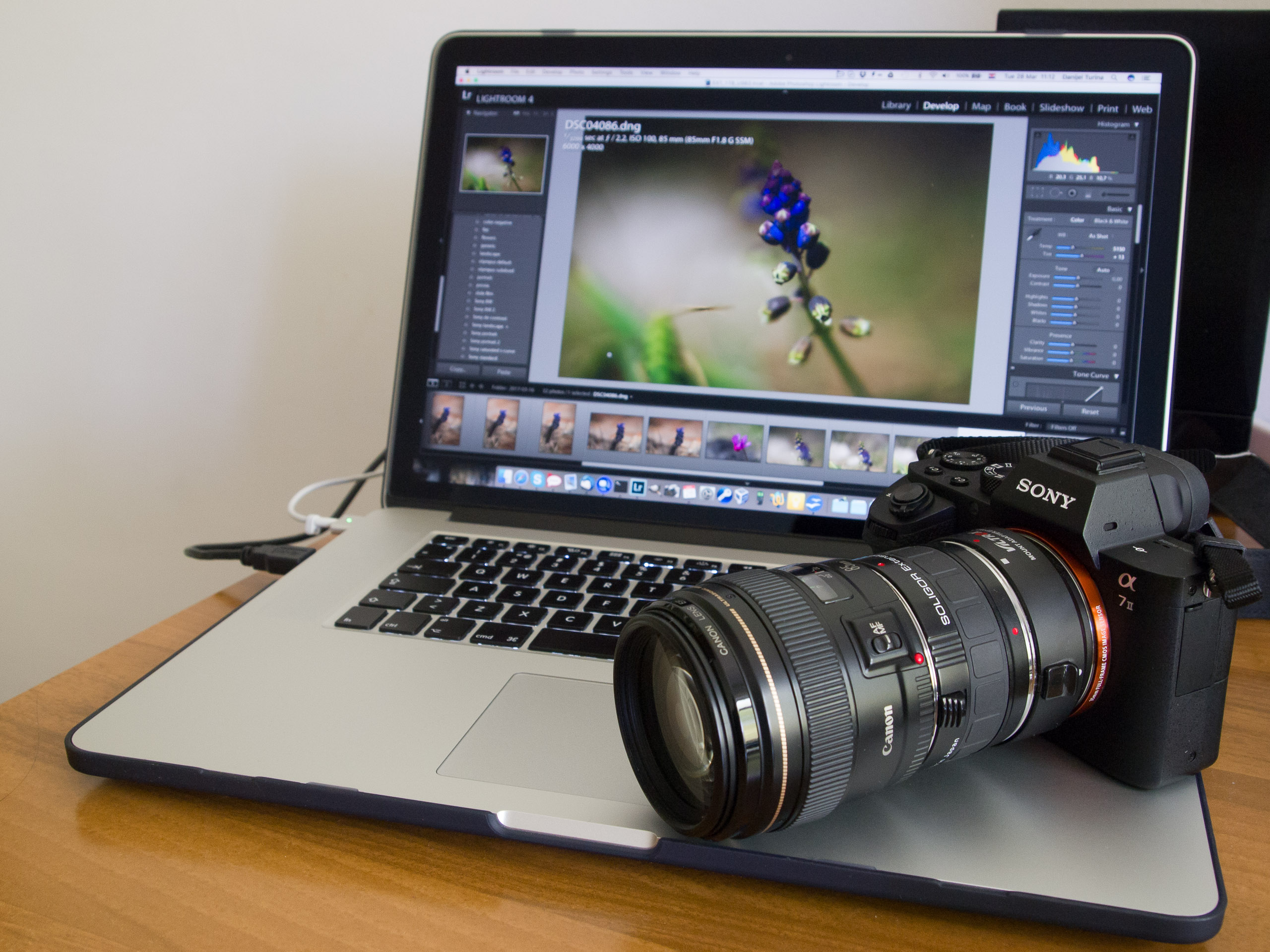
And what brand name is on what, I don’t give a single shit. I used to have a Sony camera, Soligor macro extenders, Viltrox adapter and Canon lens as a singular working system. As long as I’m getting the results, it might be literally anything. Within reason, of course; I won’t buy something that’s better than what I need. Some specialist professional piece of gear that’s super expensive and designed for specialists with needs different from mine will be shrugged at and ignored. I won’t buy it just because it’s great, if it’s not great for my needs. I certainly won’t aspirationally buy Leica or Hasselblad just to look “serious”.

So, materialism, in a sense of buying physical objects for their physical properties and function. I heartily recommend it. Idealism, in a sense of aspirationally buying exclusive branded items for their elusive spiritual properties… fuck that.

Idealistic spending

I was just thinking how a common interpretation of striving to attain things is that people believe things will bring them happiness. I don’t think this is what we are seeing. I think people buy things for their symbolism, and the entire thing is some kind of magical thinking, or even an unconscious magical ritual, where they think that, by putting symbols of success, wealth or fame onto themselves they will increasingly participate in the desired outcome.

In that sense, they are some sort of idealists, because they see things for their social and emotional value, not their material value, and I’m some sort of a materialist, because I buy things mostly for their physical utilitarian value. For instance, I buy coffee cups in order to drink coffee from them. I don’t care how fancy they are. They need to be the right size, nice enough shape and they need to be durable, inexpensive and locally available. All of those things are physical properties, and emotional or social significance of those cups is zero.

Nothing fancy.

However, when someone buys coffee cups from a fancy brand, and wants them to increase the perceived social standing of the household in the eyes of guests, they are doing it for the ideal, not material properties of the object.

I’m not saying I’m never buying things for their perceived meaning. I do, when it’s useful. For instance, when I need to maintain an impression in order to “pass” socially, I’ll buy a thing or two for their status symbolism, but I’ll try to be reasonable about it and not overspend. This, however, is also mostly functional, because I see the symbolism as part of the utility. I know how people think, what they perceive, what conclusions they will make, and I know what impression I want to make in order to have the least possible amount of issues. So, apparently, sometimes the symbolism of status is a commodity to be purchased.

But this is a completely different thing from believing that, if you buy enough expensive things, you will magically become more successful and wealthy. No; you’ll be poorer, because wasting money on depreciating symbolic assets doesn’t do absolutely anything, other than make people think you’re an idiot. There are people who are so obsessed with things, that you can precisely assess the amount of money they have by whether they bought some symbolic asset or not. For instance, if he didn’t buy a Rolex, you can tell for sure he has less money than the price of that Rolex, because he would have bought it even if he had exactly that much money and not a Euro more. If he had enough money to buy a Mercedes, he would have certainly bought it.

The concept that you can be rational and calculated about those things is, apparently, too much for some people. The “magical” power of material symbols is too great for them to resist, because they actually think this is the way you make progress. You buy Mercedes, wear Rolex and eat lobster all the way to material success. It’s insanity, but that’s how they think. I, on the other hand, think that status symbols are the fastest way to financial ruin, and one should avoid them as much as possible and instead act rationally and frugally, but within reason and until a point.

The limit of frugality, in my opinion, is respect for yourself, your work and your family. If you respect your family you won’t allow them to wear rags and look homeless. If you respect your work you will buy yourself good tools. Also, you will purchase sufficient symbols of status to shield your family from social pressures. So, status symbols are somewhat necessary and you can’t completely avoid them, but if you’re rational about it, they won’t cost you much more than purely utilitarian things of good quality. You just need to know what you’re doing and be purposeful and deliberate about it. Also, you need to avoid growing expenses to match and exceed your income, because that’s deadly.

For instance, there’s a pretty defined amount I’m willing to pay for a watch, regardless of how much money I have. I’ve heard statements that a watch should cost a month or two of your income, but I completely disagree with that. I would never buy a watch that expensive. Instead, my limit for a watch is my monthly budget for discretionary spending. Just think about it: a monthly income isn’t something you can recover in a month. You have expenses – rent, bills, food, fuel and so on. When you remove standard expenses from your income, the rest is what you can comfortably spend on something and not get yourself into trouble. In order to recover a full month of income, you need to pay it off from multiple months’ worth of discretionary spending budget, and depending on your actual numbers, that can be a very long time. So, if your discretionary budget is 10% of your income, it will take you 10 months of that to recover your monthly income, if you burned it on a watch. So, essentially, you’ll have to live on bare necessities for 10 months to pay for a gadget. You see how insane that “rule” is?

So, rather than defining “what I can afford” as the amount I can pay without dying, I define it as the amount I can pay without feeling any adverse effects. This means I can afford much less than people who will go into debt and destitution just to prove a fictitious point. I do, however, prefer having actual money, to creating an impression of having money. Impressions are sometimes useful, but it is my experience that they peak out very quickly.

Illusion over substance

I’ve been thinking about how I don’t care about the appearance or an illusion of a thing, and would rather have the thing itself, and how often people do the opposite – sacrifice a thing in order to have the appearance of it.

Perhaps that’s too abstract, but let’s take luxury goods as an example. Unlike what people tend to think, they are not something rich people buy because they can afford it. They are something middle class and actually poor people aspirationally buy in order to create an impression of wealth, thinking it will magically attract wealth into their lives if they appropriate its appearance, or something. And sure, there is a segment of rich people who also buy luxury goods in order to create the appearance that their lives are not empty and meaningless and that their wealth did actually help them achieve some worthwhile thing. However, most wealthy people invest in projects that are actually worthwhile, at least in their opinion. Traditionally, libraries, hospitals etc. bear names of their wealthy donors. They finance welfare projects for the poor, infrastructure, science and so on. Sure, they will buy a big mansion, yacht and jet plane, but the majority of their focus usually lies in making something lasting in the world they will be remembered for. Also, unlike the aspirational middle class, the people who think they will be perceived as belonging to the important class by wearing a Rolex and an expensive suit, the actually wealthy people are known by name. You get to be important by doing something that matters, not by puffing yourself up with status symbols that define your status – as that of a desperate wannabe social climber.

So, what do status symbols actually do? They convert actual money into appearance of wealth, and in the case of middle class people, they aggravate their actual financial situation by incurring debt and depleting their bank account instead of that money being invested into something that will actually help them – basically, if you want to improve your social standing, buying LVMH shares will do more for you than buying their products.

Cars are likely the worst, since they cost a significant portion of a real-estate purchase, they depreciate rapidly and need to be replaced with some regularity, and if you want to use a car as a status symbol, you’d have to refresh it every five years or less, and that will be such an impact to your finances, it might actually prevent you from achieving any worthy goals. The expensive cars are for people what Pleistocene tar pits were for wolves and sabretooth cats – an irresistibly attractive fatal thing where their bones get to be found at a later date.

In both cases – cars and luxury goods – you create an appearance of wealth at the cost of wealth itself. It is something that doesn’t matter if you’re so wealthy that this doesn’t actually cut into your wealth significantly, or at least no more than a good dinner cuts into the income of an average person. For instance, if the price of your car is your annual income, such a purchase is literally destroying your financial future. But if the price of your car is one or two months of your income, and you keep the car until the entirety of its useful life had been exhausted, this might be a reasonable and frugal purchase. But have this in mind: a very rich person will buy an expensive car for their pocket money. It will be a fraction of their monthly income. If you try to imitate them, you probably could, but you will have to financially destroy yourself in the attempt, and it will do absolutely nothing useful for you. It won’t make you rich, it will make you poorer. It won’t get you into the company of rich people where you’ll do business and become one of them. You’d still have to figure out how to do that regardless of the car. You’re buying an illusion of wealth at the cost of the actual thing.

There are things other than wealth where this applies as well – for instance, sacrificing happiness in order to obtain the illusion of it, but wealth is the easiest example. The most fatal one, however, is spiritual advancement, where one has to choose between the thing and appearance thereof very early on, and almost everybody chooses to appear spiritual. You can imagine what that looks like – read the right books so you know the lingo, be vegetarian, believe in karma and reincarnation, and so on. Add celibacy and poverty for the next level. Do that for twenty years, and you’re perceived as a genuine spiritual seeker. The problem is, not only did you achieve absolutely nothing of value in the spiritual sense; you achieved things that are making it impossible for you to even start. You made yourself into a circus act. And, most importantly, you have your “achievements” to defend as a matter of ego support structure, which means you won’t listen to good advice and change your stupid behaviour when someone like me tells you’re merely making a fool out of yourself. Essentially, you sacrificed the possibility of getting the real thing in order to obtain the appearance thereof.

Why do people do it?

Because it’s easy to copy the appearance of something; or, at least people think it is, if they believe they know what the real thing is supposed to look like, and in the case of spirituality, they absolutely don’t. They also have “magical thinking”, and they believe that if they become similar enough to something in appearance, this will make them more like that thing in substance. It’s a “cargo cult” mentality.

Let me tell you how you become rich. You do it by having more money and other assets. You don’t do it by having expensive shit on you. You become “spiritual” by having the soul structure and size of the angels and persons of God. It’s not done by trying to make yourself into a stereotypical cultist. I know that children learn by pretending to be, or at least they think they learn, and adults seemingly just keep this up but in the adult version, but it’s not working. It didn’t work for you when your were children, and it’s certainly not working for you as adults. Imitation is not a way of becoming – it’s a way of losing substance in order to obtain appearance. Just stop it.

Getting shit done

I was writing something in the comment section that deserves to be an article, with some additions:

I definitely subscribe more to the “clean” line of thinking – don’t clutter the place with extraneous crap, avoid things that don’t actually improve your quality of life, and if something doesn’t do anything good for you, it probably just drags you down. I had to move too many times, and that’s a good way to learn that stuff that normally doesn’t get in the way but isn’t really useful either still needs to be packed and moved, and as such is a drag. However, there’s a serious difference between that, and trying to get rid of almost everything. Sure, you can say you don’t need winter clothing in the summer, but when the winter comes you’re going to remember what you needed that heavy jacket/coat for. When I’m not doing heavy lifting with my computer, I think that Macbook Air is all I need, but then I get to import lots of pictures and a desktop machine with good cooling shows what I bought it for. One can say things don’t make you happy. Sure, my car doesn’t make me happy, but not having one would sure make me miserable. You don’t get to be happy from things; however, believing that things are here to make you happy is stupid nonsense. Things are here to prevent hardship and misery. They are here to help you do something useful. If they serve some additional purpose, such as look good while being functional, the better. Having a sharp knife never made me happy. Having a dull knife, or not having an extra knife while they were all in the dishwasher sure annoyed me. But the difference between a perfectly functional knife, and some fancy Japanese $500 knife doesn’t mean shit to me. I buy them cheaply in the local mall, and I have good sharpening stones to maintain them. As long as it’s sharp and good, I don’t care about it being fancy. Same with the dishes – they are all the cheapest, locally available brand, and if we break something, it’s easily replaced. No fancy handmade porcelain and shit. We buy it either in Ikea or the local store. Cheap, simple, functional. That’s how I perceive minimalism – don’t waste money and mental energy on stuff that doesn’t matter, because it’s impossible to get it to be better with any kind of investment once you get past the basics. Essentially, get fancy coffee, serve it in the cheapest generic cups. Fancy coffee can improve things, fancy cups can’t, because the basic cups are already really good. Also, there’s minimalism in reducing the amount of overhead introduced by unnecessary fancification of things. Get stuff that you can easily service and replace. Get as much stuff from the same place as possible, because it simplifies delivery, maintenance and replacement. I’ll get furniture from Ikea, for instance, not because I’m much of a fan, but because it makes it simple enough and it’s good enough and once I’m done with it I can do something more important. Also, buying stuff from Apple simplifies things a lot – it reduces the amount of choices that don’t actually contribute to anything, the stuff is well made, lasts long and so on. So, minimalism in a sense of reducing the amount of shit you have to deal with it is something I definitely subscribe to. That doesn’t necessarily mean less things, but it means dealing with unimportant aspects of things less. For instance, trying to get things to be fancy, beyond the layer of functionality, is an incredible waste of energy, money and time. For instance, I don’t have fancy shoes, I have generic Adidas sneakers that are comfortable and good, and I know the exact model and size so I order replacements online once I wear them down. Same with clothes – I get good generic stuff that’s easy to find and replace. Basically, I like the Bauhaus concept of industrial design, form following function, and mass production reducing cost. Sure, I like fancy here and there, but for the most part, I prefer to have the most generic mid-range version of a thing, because that one is most likely to be good, easy to find, cheap to buy and replace, and so on.

I was thinking about this more, and concluded that there are some exceptions to my general rule of just getting shit done and not wasting money and effort on pointless fancification. Those exceptions come into play when something fancy actually means something to me, or I have it to create an impression that serves some useful purpose, and creating a wrong impression would cause more problems than it would solve.

The most important exceptions are cars and watches. In both cases, I will go beyond the minimum of function, and rather treat their symbolism of status as an important aspect of function.

You see, it doesn’t matter whether I care about those things or not. Other people care about them and notice them subconsciously, and I need to do the necessary minimum to “pass” if I want to aviod hassle that might require inordinate amounts of mental focus and energy to break through. I want to create an impression of someone you have to take seriously, but not someone who intentionally provokes envy and spite with ostentatious behaviour. I also don’t want to waste money on status symbols, at least not beyond the point where it suffices to accomplish the intended purpose. It’s a delicate dance. Status symbols have a nasty tendency of backfiring more often than not, because fake people tend to overdo it. You can’t fake class, and you can’t fake the feeling you have when you know you have money. But there are things that a person with money and class could reasonably be expected to do if they wish to avoid ostentatious displays; and then there are things such a person would not do. For instance, wearing a tacky gold-plated supermarket-brand watch is one of those things. But a very rich and classy person could wear an 1980s Casio. Also, if people know or suspect you are tight with money, ostentatious displays will instantly backfire. There are very, very few instances where showing that you have money will benefit you. It’s actually the opposite from what poor people, who want to pretend to be wealthy, think. More often than not, behaving frugally, rationally and “low key” will indicate money and class. Ostentatious behaviour, to me, indicates serious money issues. That can mean not having money, or being stuck somewhere in your past where you didn’t have money, and trying to overcompensate. In any case, it isn’t a good look.

So, my paradigm of prioritising function and getting shit done sometimes means matching some social expectations closely enough to avoid problems. It also includes some level of indulgence. If combining reasonable indulgence with functionality manages to make it easier for me to accomplish my goals, the better. The curve that connects the dots might in fact meet the requirements of minimalism, but the way I see it, minimalism can be an emergent property of trying to get shit done with the least amount of friction and issues, and not necessarily something that has anything to do with striving to have less things.

Minimalistic choices

Internet is full of videos and articles on the theme of “if you had to take one camera and one lens and use it for the next ten years, what would it be”. Or it’s “if you had to have only one computer, watch, pocket knife, car, pen…, what would it be”.

It always implies some kind of a “less is more” situation – basically, when you’re forced to use limited tools, you compensate with creativity and the results tend to be better than if you subscribe to “more is better” paradigm. Sure, sometimes. However, for the most part that’s all nonsense.

When you actually have a limiting situation, it’s not a choice between three different macbooks, a desktop computer and a gaming Windows laptop, and deciding to keep just one. It’s a situation where you have the cheapest possible computer that has minimal functionality for your daily tasks, and when you have to do something harder, it all starts to crumble under your fingers. Ask me how I know.

I had minimalist setups because I was poor, not because I subscribed to some stupid post-modernist minimalist paradigm where you own nothing and are happy. I owned nothing because it was an actual situation, and not some bullshit for YouTubers. Extreme poverty introduces its own kind of minimalism, and trust me, it doesn’t make you happy. It doesn’t reduce mental clutter – on the contrary.

Having a Macbook Pro that connects to Apple Studio Display with a single cable, with clean wireless mouse and keyboard setups, isn’t a realistic minimalist situation. Not having a desk and instead putting the cheap bulky computer you got used on the flimsy kitchen desk you found in the apartment you’re renting cheaply, that’s realistic minimalism. Working with whatever camera and lens you could get for the least possible amount of money because you couldn’t afford anything better, that’s realistic minimalism. It’s not a choice between ten excellent lenses and artificially limiting yourself to one. It’s using the one you found for 25 EUR on ebay because you had 25 EUR plus shipping, that’s realistic minimalism.

Minimalism isn’t a choice of one watch; minimalism is when you only have one watch, and it’s cheap because cheap is all you could afford. And by cheap I mean 50 EUR. Any by 50 EUR I mean you had to save for several months to be able to afford a 50 EUR watch, and you think it’s unjustifiable luxury. Ask me how I know.

When you’re poor, minimalism means you can’t replace your jeans, which have holes on them, because you had to replace your shoes first, because they too have holes on them. True minimalism isn’t a clean desk setup because you are decluttering. It’s an empty flimsy desk with nothing on it because that’s what you have.

When I see how people justify their minimalist setups, I can’t believe the nonsense I’m hearing. Like, they are using single-task devices such as typewriters or dedicated computers with no networking and only minimal software, so that they aren’t interrupted by all sorts of notifications and social media while they write. Excuse me, but that’s a matter that requires mental training, and not different equipment choices. When I open a word processor and write something, I can have literally dozens of things open in the background and I don’t notice any of them. I actually don’t hear what my wife is saying to me in person, and I have to ask her to repeat it later, because when I’m concentrating on writing, nothing else exists. It goes to such extremes that I can freeze behind the computer and get sick later because it was cold and I didn’t register it, because what I was doing took literally 100% concentration, to the point that I don’t register pain, hunger, hot, cold, noise, earthquake or aerial bombardment when I’m working. I don’t care about minimalism because when I’m working, I don’t perceive anything on my desk, or on my computer besides the program I’m using for the work I’m doing. I don’t need to have a clean desk with the smallest possible number of items on it, because otherwise my mind would be cluttered. On the contrary – my mind works like a switch, because that’s how I trained myself. When I’m doing something, nothing else exists; not because it’s not there, but because selective concentration is not a matter of having less things. It’s about focusing on just one thing, despite being surrounded by the entire world of things.

There’s a word in Croatian, “izdrkavanje”, which would literally translate as a wank job, but which means performative actions, things you do so that the audience would perceive how awesome you are. That’s how I perceive the performative minimalism. Its purpose is convincing other people that you have an organized mind because you have a clean desk from Ikea, with just a laptop, monitor, a wireless keyboard and a wireless mouse on it, with a possible addition of fake grass in a pot from Ikea. People who have such setups usually have nothing better to do than waste time on such performative minimalism, where an actually focused person would have all sorts of stuff lying around, while they are focused on just that one thing they are doing, and they don’t have time and energy to waste on performative actions intended for impressing anyone.

They usually say that minimalism reduces the overhead of choice – for instance, you don’t have to think about which lens you’re going to use because you only have one. Oh, the agony of choice; you need to pick one for that day. How horrible. If choice is hard, I just take what’s already on the camera, because if it mattered, the choice would be simple. What pencil or pen to choose? The one that’s closest to the paper, usually. If it actually matters, then I go to the pencil cup and pick a more adequate one.

I’m not advocating for chaos and lack of organization and tidiness. I’m saying that a minimalist setup is performative nonsense that takes more time and energy to maintain than a reasonably cluttered setup, and shows that your energy goes into showing other people how minimalist, tidy and clean you are, rather than getting shit done as efficiently as possible.