Failures at the right-wing

There’s no reason for me to criticise the left-wing politics any more. They are so obviously insane that nobody in his right mind needs any kind of argument regarding this. However, I am increasingly troubled by the right-wing apologists, and I’m going to explain my reasoning here. However, this might be difficult since I’ve been thinking about this extensively and the depth and scope of my true analysis will certainly exceed the limitations of a single article. For this reason, I’ll try to start with the conclusion, and then branch the argument further until I get something usable.

The conclusion is that they have nothing to offer that hadn’t been tried already, and the attempts to fix the problems that arose in the historical attempts to implement their ideas gradually produced the mess of a political scene and, on a more profound level, a dysfunctional civilization in the process of collapse.

They offer nationalism as a remedy for globalism, secularism as a remedy for the infiltration of Islam into the social fabric of the West, occasionally they resort to some sort of a spiritually vapid form of Christianity as a remedy for the even more spiritually vapid secular atheism, they assume that the separation of Church and State is the way to go, democracy is implicitly assumed as a superior solution, they never question the concept of the rule of law as opposed to the rule of specific individuals, they never question the concept of shielding oneself from the corruptibility of individuals by resorting to impersonal bureaucracy and legislature, they never question equality of individuals before law, and so on. However, we already are very close to the end-result of following those implicit premises to their logical conclusions, into madness and evil.

What the right-wing apologists are saying now is that they would like secularism and separation of rule from person, but that’s how we got the slaughterhouse that was the French revolution. They say that nationalism is preferable to globalism and internationalism, but nationalism resulted in two world wars of the 20th century, and internationalism and globalism were thought of as remedies for the evils and extremes of nationalism. They ridicule the leftist gender bullshit and extreme egalitarianism, but all those things were the result of accepting the assumption that Hitler was wrong in the core aspects of his politics, and that he was defeated in the second world war because he was wrong, not because he had weaker military and less resources. You can’t be both virgin and fucked. Hitler came to power as a remedy for the leftist madness of the Weimar republic, which was very similar to what we are having today. What the right-wingers of today are tiptoeing around is the fact that Hitler was more right than he was wrong. He was wrong about solving problems with genocide. He was wrong saying that the Germans are a superior race, and then in the same breath saying they need help competing with the Jews in a meritocratic society. He, too, tried to have it both ways – if the Germans are superior, then you don’t need genocide, racial laws, and segregation of the “inferior races”. If you consistently implement meritocracy, the superior ones will win, however the results might not be neatly aligned across racial and national lines, which is why Hitler couldn’t allow it; the results would contradict his ideology. He was right about opposing degeneracy in art, culture and science. He was right saying that the nature and the environment must be protected. He was right stating that the races and people are different and that there are superior and inferior ones, he just couldn’t bear to act as if this was actually a fact and introduce completely meritocratic laws. He was right stating that the genetically defective humans should not reproduce and that human reproduction should conform to eugenic guidelines, he just forgot that implementing eugenics without regard to compassion and love would produce a dysgenic human race. He was wrong about many things, but he was also right about enough things that he ought not be dismissed out of hand without carefully considering his arguments, and he was certainly not wrong enough to be used as a standard for evil and wrongness. However, if there’s something both left and right of today’s politics agree on, it’s that Hitler was evil and that the “good guys” won the second world war. Also, they agree that the right side won the French revolution, and that all basic precepts of secularism are valid. This is why the political right of today is unable to offer solutions that don’t consist of performing a rollback to some already tried and failed state. They have no original, new, radical solutions. Nothing that hasn’t already been tried, and nothing that hasn’t already failed so badly that it produced the main-stream politics of today as an attempted solution.

It’s interesting how the Jews act as if Hitler was more right than he was wrong; they accept the fact that there are races of different value, they just think they are the superior race. They accept the fact that a superior race can use genocide and violence against inferior races and peoples that threaten it, and they use those measures against the Arabs. Basically, the only thing they have against Hitler is that he was on the opposite side and a threat, but they accept his basic assumptions and methods. If they can do this, and they would in theory have every right to assume he was wrong about everything and accept him as the etalon of evil, where opposite of Hitler is good, there is obviously something quite not right about the European right-wing in their willingness to accept the assumptions that Israel, despite all reasons for the opposite, was unwilling to accept. That’s why Israel is, in my opinion, a spiritually much healthier society than Europe. They, at least, are ready to accept the premise that they are the best, that they are worthy, that they have the right to assume supremacy and rule over others, and if something is different from them, it’s probably because it’s worse. If a civilization is unwilling to accept those premises, it ceases to defend its right to exist and to fight others for supremacy and, even existence. If a civilization, or a person, approaches life from a position of cynicism and scepticism towards oneself, it is by definition degenerate and in the process of extinction. If you don’t think you’re the best, you are basically calling others with less scruples to wipe you out and take your place. That’s how things work. You can’t have a healthy, or even sane society if you are unwilling to accept the fact that the same fair rules must apply to everyone, and that those who succeeded under those rules deserved to succeed, and those who didn’t most likely deserved to fail. And you also can’t have a sane and functional society if you are unwilling to inspect those who failed and determine which ones failed due to no fault of their own and help them as a community, and which ones failed because they are no good, and allow them to suffer the consequences of their poor choices and serve as a reminder to others.

Crisis indicators

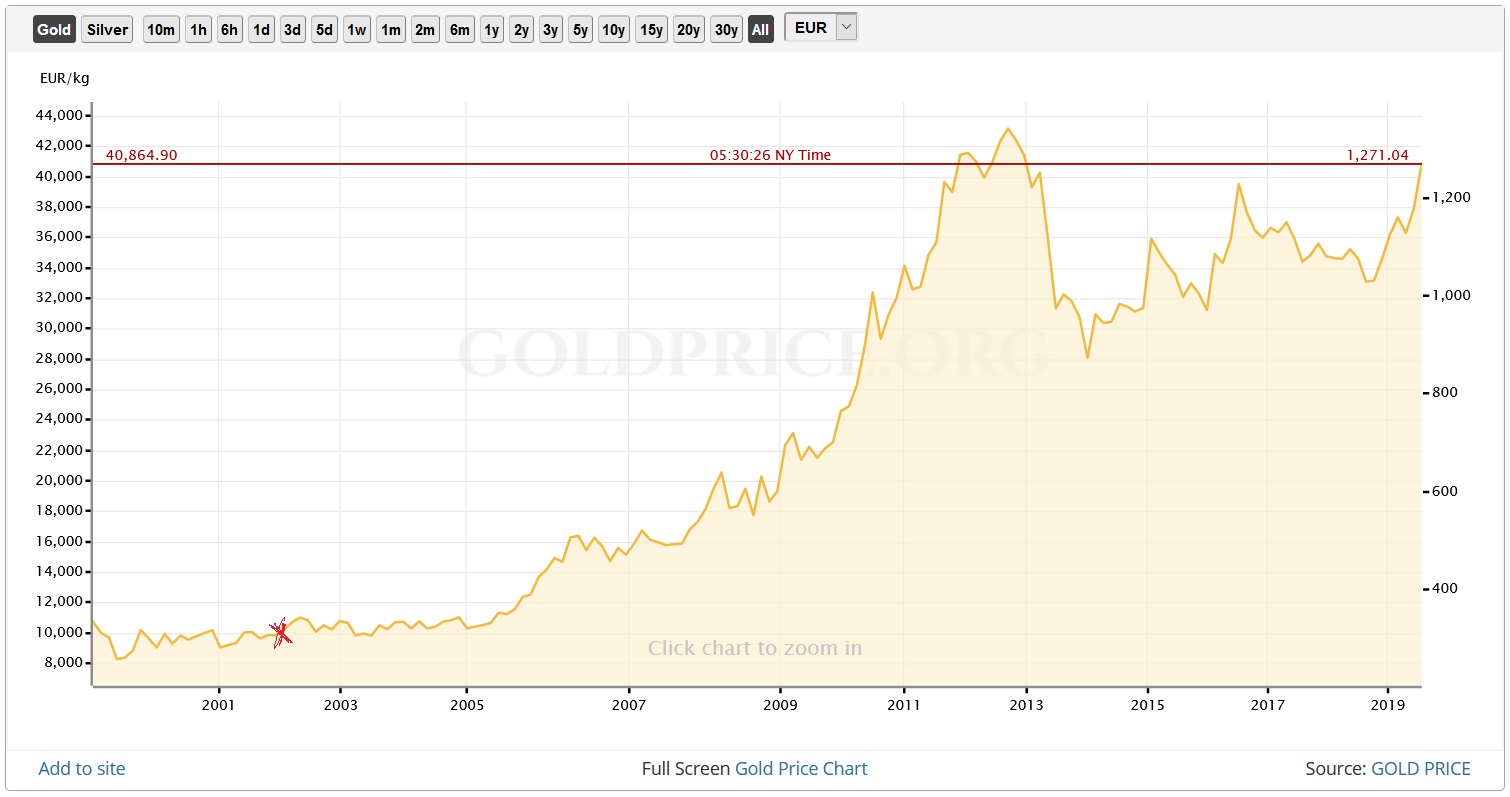
Gold price is up:

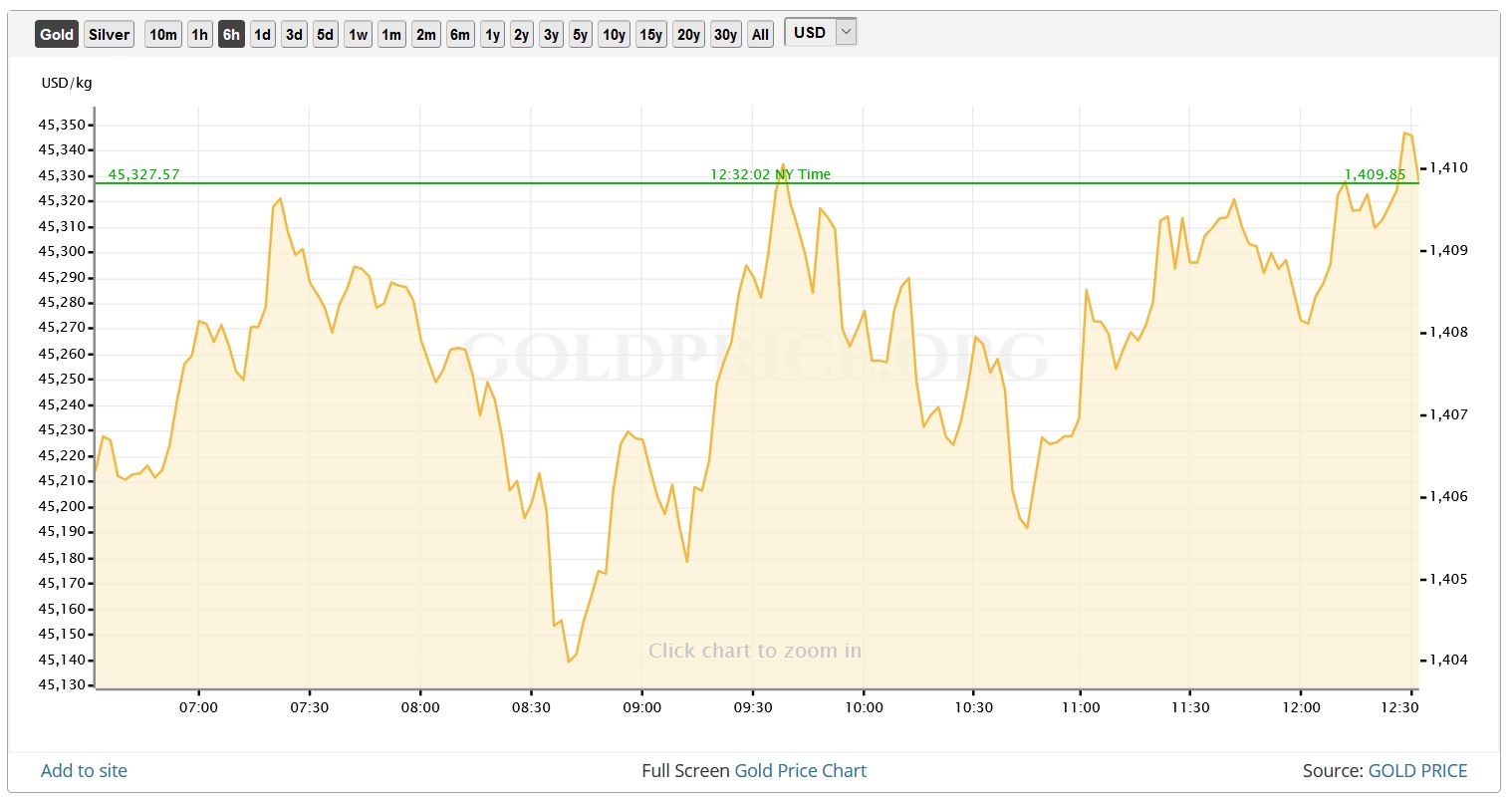
It’s the highest it’s been since the panic-spike in 2011-2013, both in EUR and USD. However, if we remove that spike from the graph and see what it looks like then, we can see something else. I’ll show you another graph, this time in USD, to make it clearer:

Let’s get some painfully obvious things out of the way. First, this is not the price of gold. It’s the value of paper currency over time, measured in gold. Some people have calculated that gold and silver can be used as a very steady marker of value from Roman times up until today, measured in things like a good suit, lunch or a goat. So, essentially, if a good suit cost you the same amount of gold in ancient Rome as it does now, it’s not gold that’s getting more expensive over time, as the graph seems to indicate. The graph shows inflation.

Another obvious thing on the graph is that paper currency doesn’t just fluctuate randomly. There are patterns: times where it keeps steady value, and inflatory spikes. Unfortunately, the graph doesn’t show the Nixon shock in 1971, where “the dollar plunged by a third during the 1970s”, or the “Executive Order 6102” from 1933, which “made gold clauses unenforceable, and changed the value of gold from $20.67 to $35 per ounce, thereby devaluing the U.S. dollar”, to quote Wikipedia.

The third obvious thing is that we are on top of a very nasty-looking inflation trend, and although one would naturally attribute that to the financial crisis of 2007-08, it appears to have started some years before that, and it’s possible that the crisis was a consequence of inflation, not the other way around. You see, the crisis was triggered by sub-prime mortgage loans market collapse, but what if the root cause was in the reduced purchasing ability of the homeowners due to inflation, triggering defaults? This is an interesting thesis that would require some deep data mining to prove or disprove.

Now we are getting into the realm of the non-obvious. Something seems to have happened around 2002 that gradually reduced the purchasing power of the populace in real terms. There are many candidates: globalization and outsourcing, printing money to finance wars, but the date itself is indicative of 9/11. Whether the event itself triggered other events that were harmful, or it was used as an excuse to implement harmful things that were being prepared in advance, that I can’t tell, because it’s probably a combination of both. However, the graph indicates that the purchasing power of EUR and USD measured in gold are continually falling on a steep curve, and my hunch says we are approaching a hyperinflatory phase of a complete economic collapse.

Let me show you another graph, of Bitcoin price over time:

My interpretation is that the post-9/11 restrictions on the financial markets and all kinds of Fascist policies with newspeak names had the result of people hysterically trying to rescue their money and the so-called crypto-currencies appeared as an alternative to the banking system, SWIFT and the credit card mafia. Bitcoin price is not a great indicator because it behaves like a high-risk investment paper, and not like a financial safe-haven, but apparently if you want a safe haven against America and the banking system, crypto is not at all bad, if you can get out of it in time, because crypto is a financial version of the Schroedinger’s cat: you can think it has value based on some graph, but you only get to learn what it’s worth when you want to sell it, basically at the point of collapse of the greed-curve.

My general recommendation is that the greatest losses in any financial crisis will be suffered to the investment papers with the highest level of abstraction. Essentially, the farther away from the real thing, the greatest the danger, because bullshit, hype, greed and deception always hide in the high levels of abstraction, which can also be read as “bullshit”. The historic lesson with complex financial packages based on bad mortgage loans should be obvious. In times directly preceding a crisis, bullshit-papers create bubbles and trick investors into buying, but when the panic starts, the value of something is always determined by how much someone is willing to pay you for it, not by what you paid for it, and when a bubble bursts, there are no longer any buyers. At that point, everybody hysterically tries to save money by putting it into safe havens, but by then it’s too late.

Essentially, buy precious metals when everybody buys high-risk, high-reward papers, and when everybody goes crazy because the bubble burst, do nothing. Wait it out, then convert metals into a rational wealth-generation plan. This is essential, because as good gold is as a store of value, it doesn’t actually produce additional value by just sitting there, and you need this generation of profit in order to be able to pay for your expenses. This is what my advice would be if this was just another big bad crisis. However, other indicators show that it’s not just about the monetary system, or the economy. The western civilization itself seems to be in its death throes, and we haven’t seen anything that bad since the fall of the Western Roman Empire.

Fake people

I can’t decide whether this AOC crazy person is funny or depressing, but take a look at this:

Fake person having fake emotions over a fake scene in order to create fake news in a fake world.

Because empathy is very useful as a tool for manipulating fools into tyranny. Fake pain results in fake outrage that results in actual laws being passed that will make you even more of a slave, and all “because children”.

Security of Linux

I was thinking a bit lately, running Linux as my daily driver for the last few days, at least on my desktop PC, about the rationale behind Linux as a secure OS.

Linux is secure because it’s open source so anyone can inspect it and find the back doors and insecure features. That’s the story.

However, a while ago they discovered an open-ssl vulnerability called “heartbleed”, which was there for years, in an open source library, that theoretically everybody could inspect, and yet apparently that didn’t help the slightest bit. How is that possible?

The explanation is quite easy. Yes, there is a huge number of people working on open source projects, but the trick is in how they are grouped. The largest majority is working on redundant high-level stuff, while the “invisible”, low-end, critical features are so obscure, that they are often maintained by either a single developer or a handful of them, and although people could in theory read some cryptographic c library, almost nobody does, because it’s obscure, difficult and unrewarding work. People who maintain those libraries need to have immense expertise, and yet they are usually paid nothing for their work. Nobody really competes for a job that requires a PhD in mathematics, a wizard-level knowledge of c, uses up lots of time, and pays nothing.

Which brings me to the main security issue in Linux: its critical security features are written and maintained by a few unpaid experts, are too obscure to read and understand by the vast majority of Linux developers, and the likely attacker can literally print billions of dollars that will never be tracked or accounted for, and has infinite means of intimidation.

This means Linux is in fact extremely vulnerable. It was proven to have “heart-bleeding” vulnerabilities out there in the open for years, and nobody actually bothered to read the open source code and find them. The vulnerability can be extremely obscure, and you’d need to be a professional cryptanalyst to be able to identify it, and there would be no incentive for you to go through all those mountains of code and find it, because you would assume it’s already been done, which is an easy and pleasant assumption to make, if somewhat unwarranted.

So, what am I saying here? Basically, I’m saying nothing is secure if those attacking the system have control of the hardware design, firmware design, operating system design, and can pay the best experts infinite amounts of money if they comply with their demands, or have them and their families disappear in darkness if they don’t. The idea, that you can simply install Linux instead of Windows and you’re secure, is incredibly naive.

New Raspberry Pi

Raspberry Pi 4B has been released recently, and it’s the first such device that might actually be usable as a general-purpose desktop PC.

I don’t know yet what the Geekbench score is, but it has 4GB RAM, can drive two 4K monitors, is 2+ times faster than the 3B+ model, has gigabit Ethernet and USB3, essentially making it an ideal cheap and secure device for running general purpose office/school applications.

I ordered one and will report how it does running Linux desktop and my typical workload. In theory, it’s the first one that actually has enough power to rival a NUC for lightweight HTPC and desktop tasks.

Update after receiving and briefly testing the 4GB unit:

Geekbench 2 (ARM build) is 4830. The score of the 3B+ is 2266.

Subjective speed is comparable to my media player, Core2Duo E6500@2900MHz, which means it’s quite usable, since that used to be my desktop machine; the speed is not up to today’s standards, but it’s not stone age. I’m using it to write this article and the speed is fine, it’s a normal desktop computer.

kde-plasma-desktop package in raspbian made a mess, and is unusable, so I’m using the default raspbian window manager. Raspbian is incredibly breakable; after attempting to install multiple window managers, everything broke in many different ways, for instance raspi-config fails to set a valid boot to GUI or boot to CLI configuration; it just does whatever, and when I startx, it complately bypasses lightdm/sddm and opens whatever (at first Raspbian default GUI, but later Mate desktop, without the ability to switch between the two. It’s simply not ready for “normies”. Window manager switching should either not work at all, or work well, without conflicting daemons/applets, and reliably selectable through either GUI or CLI. I can’t believe I have to even say this.

The video works marginally OK when I use the legacy open-gl driver in raspi-config. 720p video works ok, only 9 dropped frames of 2800. Everything above 720p is not smooth. The mouse moves better now too.

Mate desktop is much, much better than the default Raspbian GUI. Normal things such as the volume buttons actually work. This machine should have Ubuntu Mate as the desktop OS, and Raspbian should be left for tinkering with hardware and emergency use only. Mate desktop, however, is good enough for normal desktop use. For instance, I couldn’t make Raspbian GUI make my mouse work non-sluggish; in mate-desktop-environment it just works. That also goes for the volume control buttons on both keyboards I tested. I could get used to this.

It’s prone to overheating. I got a high temperature icon repeatedly while working at the Raspbian desktop while performing apt-get install of a large dependency tree. The temps were above 80°C with alu heatsink glued to the CPU but plastic top of the case closed. I opened it now and the temps while just typing this are 66°C.
I plugged the USB3 powered hub from the desktop to the Pi and it just worked, plug&play, with all the devices.

There’s some super-weird shit going on with overheating. For instance, I forgot a Kingston USB drive in the device, and when I wanted to remove it, it was hot, like, incredibly hot. I can’t remember whether that was the case with 3B+ but this isn’t normal, since the drive was idling, and not copying the universe. 
The CPU temperature is now 62-66°C, which is about ten degrees more than 3B+ in similar workloads. This CPU needs stronger cooling, and that’s normal since it has the power of an E6500 which has a regular PC heatsink with a fan, and this has a small passive heatsink. 
The video drivers are generally the weakest spot of the OS so far, from what I can tell. All kinds of artifacting is going on while video is playing; mouse pointer hiding and showing, browser randomly redrawing, that kind of crap. It’s alpha release. I don’t think the hardware acceleration is turned on at all. There needs to be a Raspbian update having the 4B in mind, because from what I recall 3B+ actually has better YouTube video.

To repeat myself, there needs to be an OS fork for Pi devices: one for tinkering with hardware, for which Raspbian is great, and one for desktop use, for classrooms or similar, and that one needs to be polished. Ubuntu-Mate seems like an awesome candidate, although I would also like to see kde-plasma-desktop working.

I am testing it on a 4K 43″ monitor, with a mechanical keyboard and Logitech G602 wireless mouse plugged into a powered USB3 hub, and it’s a very comfortable desktop experience, until I get an idea of playing video. That part just doesn’t work well and needs to be fixed in a Raspbian update. This hub also provides the power for the Pi; I also tried a 45W USB-C Asus laptop brick, and Apple iPad brick. The iPad brick was the only one not providing enough power; I had constant undervolt notifications and at one point device actually crashed during a power peak when starting Mate. Have this in mind; this requires a netbook-level power brick, not a phone or tablet-level one. This is not your old Raspberry Pi that could run from a computer’s USB socket and be fine. The power demands are still nowhere near any kind of a x86 desktop computer, but it matches the small and frugal laptops. The overheating has apparently been resolved once I removed the top cover on the case. It would actually make good use of a slow case fan blowing on it, but a high-RPM small fan would be terribly counterproductive. The solution I would prefer would be this:

Aluminium case design where the entire top part of the case is a heatsink would be quite appropriate for a machine of this power, because if you close it inside an un-ventilated plastic enclosure it will melt itself to death, and if it’s left open it can be damaged in all sorts of ways in a classroom environment. Essentially, I’d install it in a VESA mounted enclosure with a large heatsink, and either extend the GPIO with a flat cable to some accessible spot on the monitor stand, or just forget about GPIO for desktop use; have a 4B model for driving a desktop environment, for coding and web/office stuff, and one small, cheap A-type unit for driving sensors and robotics. You’ll do the development/deployment/testing over a ssh connection in any case, it’s just a matter whether you do the development on a “proper” desktop PC, or a desktop-level Pi. As far as I’m concerned, 4B needs a software update that will fix its video problems, and make a mate-desktop-environment a default option in Raspbian: well tested, polished and not conflicting with the unnecessary LXDE and whatever GUI that used to make sense on the older generations. This one needs a choice between Mate, XFCE and KDE, not between SHIT and CRAP. Yes, this is high praise coming from me, and means the device itself is quite excellent for the intended purpose. With proper cooling, properly implemented video codecs and some OS polishing, this could be the ideal classroom computer: cheap, small, integrated into the monitor for robustness, and fast enough to run everything kids would need to learn. And it’s cheap enough you can equip classrooms with it even in the financially not so well off schools that can’t afford i3 or i5 desktops. So, thumbs up, but with a caveat regarding the OS which is obviously an alpha-release considering the needs of this device. I can hardly wait for Ubuntu Mate to be compiled and tweaked for 4B.